Pages

Showing posts with label #D100bloggerPD. Show all posts

#D100bloggerPD Book Study Kickoff on 'Daring Greatly: How the Courage to Be Vulnerable Transforms the Way We Live, Love, Parent, and Lead'

Welcome back for another #D100bloggerPD crew book study. I always take pleasure in starting our book study kickoff with an introduction of the crew. We consist of an assortment of Berwyn South School District teacher and administrator learners who enjoy blogging, are smitten with social media and make use of our PLNs as an irreplaceable source of powerful content, hence the hashtag #D100bloggerPD. We devote ourselves to staying globally connected. The crew embraces change, strives to better ourselves professionally, desires to join forces with our PLNs to share what we learn, and aims to inspire others (#D100inspires) because we are better together.

Our #D100bloggerPD book study is dedicated to Brené Brown's Daring Greatly: How the Courage to Be Vulnerable Transforms the Way We Live, Love, Parent, and LeadEven though this is the first book I've read by Brené Brown, it certainly won't be the last. (I've already started Dare to Lead: Brave Work, Tough Conversations, Whole Hearts!) If I were to have read this book and watched Brown's TEDTalk sooner, the opportunity for an awakening would have come to me a few years prior to 2019. Live and learn, I guess. :)


Daring Greatly is a *food for the soul* type of book. I've already witnessed how Daring Greatly is an invaluable, necessary, hopeful and inspiring book. It highlights Brené Brown's years of research on vulnerability and shame and her commitment to dispel the myth that vulnerability is a weakness. This post focuses on the first sections of her book, including What It Means to Dare GreatlyIntroduction: My Adventures into the Arena, and Chapter 1- Scarcity: Looking Inside Our Culture of "Never Enough." I also added a few thought-provoking quotes I found within the Facebook group, which are applicable to the first portions of the book. Let's get started. 

What It Means to Dare Greatly
Right out of the gates, Brown voices, Rather than sitting on the sidelines and hurling judgment and advice, we must dare to show up and let ourselves be seen. This is vulnerability. This is daring greatly (p. 2). 
Brown's book centers around Theodore Roosevelt's speech given in 1910, which uses the term daring greatly and the idea that we must be courageous and willing to engage in order to step into life's arena. 
Daring greatly is about getting uncomfortable, being unsure and feeling exposed. It's about raw emotions out in the open. It's being truly seen by others. #VulnerabilityRocks ;)
Introduction: My Adventures into the Arena
According to Brown, she's spent her entire life attempting to outsmart vulnerability (p.7). In the introduction, Brown shares a take away from her years studying social work. Her original view was that social work is all about fixing things, but in actuality, she's learned it's about leaning in and being able to connect. Humans are all about connection. We are hardwired to connect with others, ...and without it there is suffering. I wanted to develop research that explained the anatomy of connection (p.8).

Brown believes our human experiences can lead us to wholehearted living. Wholehearted people are those who believe in their worthiness and are most resilient to shame.
As Brown discusses her adventures into the arena, she mentions her well-known TEDTalk, The Power of Vulnerability. She was asked to dare greatly in June of 2010 at TEDxHouston. Brown explains her agreement to speak at TEDxHouston stemmed from faith in her research, not necessarily from self-confidence. Vulnerability would take me where I wanted or maybe needed to go (p.13). Even though Brown claims she had the worst vulnerability hangover after the TEDTalk, the sharing of her research caused her to write Daring Greatly. I'm so glad she did because it has given me, and I'm sure so many others, clarity on being vulnerable to live life to the fullest. 
We all have the power and desire (even, if unknowingly, at first) to unlock our own doors to a fully-engaged self. Challenges of stepping into the arena have been experienced by us all. I found it reassuring to read Brown's own challenging moments, including her TEDTalk experience, as well as the personal stories shared by those connected to her research.

When I think about my educational career, from entering the teaching field as a student teacher, to changing grade levels as a classroom teacher, to becoming a Reading Specialist and now a Literacy Coach, I've unquestionably experienced the arena. During my journey, I've floundered in the zone of uncertainty, become well-versed in awkward moments and have been exposed to minor and major failures along the way.

A daring greatly experience I'm grateful for includes my colleague and friend, Michelle over at BigTime Literacy. A handful of years ago, we decided to present together at the Illinois Reading Council Conference, which was new to me, but something Michelle had done before. You see, Michelle dares greatly on a daily basis, and since I admire her and her courageous acts, I followed Michelle's lead and jumped on board.
I'm not a huge fan of public speaking. As Jerry Seinfeld says, people's number one fear is public speakingMy agreement to present in front of strangers at a highly attended conference was a huge step towards leaning in to all vulnerability has to offer. After taking that first step into the arena, I've continued to present at conferences (once more with Michelle at our district's iEngage Conference), as well as at district Institute Days, staff meetings and more. Thanks, Michelle! ;) Beyond this specific experience, I want you to know every member that has popped in and out of the #D100bloggerPD Crew over the years is in the arena beside me. We all dare greatly and have given support to one another. I commend them all! 
Brown states the core of Daring Greatly is this: What we know matters, but who we are matters more. Being rather than knowing requires showing up and letting ourselves be seen (p.16).
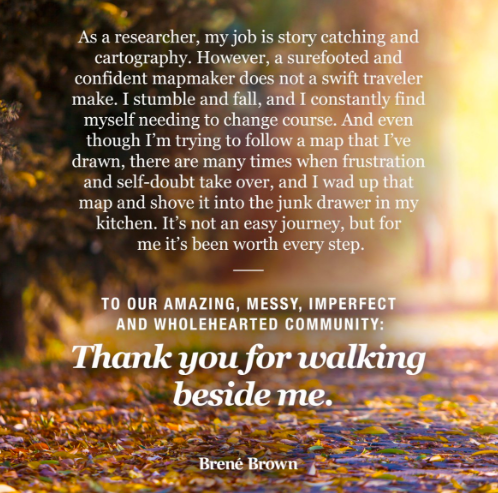
Chapter 1- Scarcity: Looking Inside Our Culture of "Never Enough" 
In the first chapter of the book, Brown takes a look at narcissism through the lens of vulnerability and the idea that people have a shame-based fear of being ordinary. She discusses how social media and reality television shows have distorted our sense of the world and has impacted some people to believe they are only as good as the number of likes on social media (p.23). This distorted outlook leads to a culture of scarcity, or the "never enough" problem. She states the culture of scarcity ...allows us to accurately identify the greatest cultural influence of our time- the environment that not only explains what everyone is calling a narcissism epidemic, but also provides a panoramic view of thoughts, behaviors, and emotions that are slowly changing who we are and how we live, love, work, lead, parent, govern, teach, and connect with one another (p.24).
 
During her research, Brown asked people to respond to the following phrase: Never__________ enoughShe explains this view of scarcity is thriving because we live in a culture where everyone is hyperaware of lack (p.26). 
We often feel self-defeated even before our feet hit the floor in the morning. Our constant comparing of ourselves to others is dangerous because, often times, we have a fictional account of how others are living or how "good they have it". We begin to set artificial goals for ourselves and then struggle to achieve them. 

This formula of shame, comparison and disengagement is not only found in the general public, but also in family, school and community cultures. Brown explains how we must all be willing to push back and challenge the culture of scarcity. We must begin living a wholehearted life, one which centers around the belief that we are all worthy and not inadequate (p.29). We must stand together to be brave and to dare greatly. The vulnerability myths that fuel scarcity will be discussed in the next chapter, so stay tuned. 

Thank you for stopping by Literacy Loving Gals to support the #D100bloggerPD book study. As the study continues in the upcoming weeks, the hyperlinks to each #D100bloggerPD crew member's post will be added below to keep Brene Brown's insights from Daring Greatly in one spot. We hope you continue to follow along with us. Next up is the amazingly talented Michelle Brezek over at BigTime Literacy with Chapter 2: Debunking the Vulnerability Myths.


#D100bloggerPD "Ditch That Textbook" Book Study!

Welcome back for another #D100bloggerPD crew book study! I always take pleasure in starting our book study kickoff with an introduction of the crew. We consist of an assortment of Berwyn South School District teacher and administrator learners who enjoy blogging, are smitten with social media and make use of our PLNs as an irreplaceable source of powerful content, hence the hashtag #D100bloggerPD. We devote ourselves to staying globally connected. The crew embraces change, strives to better ourselves professionally, desires to join forces with our PLNs to share what we learn, and aims to inspire others (#D100inspires) because we are better together.

This #D100bloggerPD book study is dedicated to Matt Miller's Ditch That Textbook: Free Your Teaching and Revolutionize Your Classroom. If you want to lead your students in educational practices that are innovative and engaging, read this book. It's yet another invaluable book published by Dave Burgess Consulting, Inc., and highlights Matt Miller's journey in creating a classroom where great learning experiences happen for students.
The book is divided into four sections: Why Go Digital?, Ditch That Mindset, Ditch That Textbook, and Ditch That Curriculum. My post for the book study kickoff consists of a portion of section one: Why Go Digital?, which includes the Introduction and the first four chapters: Chapter 1: Free Access, Chapter 2: Boost Your Efficiency, Chapter 3: Use Technology to Defeat Insecurity, and Chapter 4: Empower Students to Find Their Passions. The chapters are brief, to the point, and filled with stories, advice and tips based on Miller's classroom experiences, so it's an effortless and fun read. Ready to dig in? :)
In the introduction to his book, Miller claims "...this book is about evolving and finding better ways to teach (p.2)." He assists in equipping our proverbial tool belts with practical, hands-on ideas that incorporate technology to globally connect our students to the world. Most likely, we all have the desire and the power to unlock the doors to fully engaged students. However, first, we must get uncomfortable, jump into the unknown, seek more advantageous ways to engross students in learning, and, of course, take risks.
On page 5, it states, "Ditch That Textbook is designed to be a support system, toolbox, and manifesto. It's a collection of ideas, considerations, and suggestions to help you free yourself as an educator to create the classroom and the teaching style you want." Let's take a look at Miller's DITCH model, which will help you get started in revolutionizing YOUR classroom.
 _____________________________________________________________________________
Why Go Digital?
Chapter 1: Free Access
Miller started out the chapter by jumping back in time with a scenario of aspiring to connect with John Dewey, the groundbreaking educational thinker and reformer from the 1900s (p.9). Miller went on to explain the lengths it would have taken him to have a mere dinner conversation with Dewey back in 1904, when Dewey was at the University of Chicago. The duration of time necessary, including the hypothetical traveling and boarding expenses, were all considered. Needless to say, it would have been quite a laborious effort for Miller to have had a professional conversation with John Dewey.    

Nowadays, however, we live in a digital world. We have access to technology, which provides an unrestricted ability to globally connect with others at a much faster rate, including researchers, authors, educators and groundbreaking educational thinkers. Using Skype, Google Hangouts, Voxer, FaceTime, and many more, are all possible from the comforts of our own home. As teachers, it is our obligation to harness these platforms, not only for our own professional development, but to apply within the classroom to better expand students' digital citizenship skills, and more fittingly prepare students for the future.      
The best thing, of course, is that connecting worldwide is FREE (for the most part). Students are now able to move from local to global connections at the touch of a button. They can learn from classrooms around the world, not just peers in their school. Take a peek below at some valuable quotes from Chapter 1Free Access. The gist? Get out there and try something new, alongside your students!
  • These previously impossible connections can revolutionize education-- if teachers are willing to give them a shot (p. 12).
  • Instead of testing a new idea or tool, "paralysis by analysis" takes hold. We overanalyze new options, mull over all of the things we don't know, think about how students will react, and then we don't act! (p. 12).


Chapter 2: Boost Your Efficiency
Who wouldn't want to be more streamlined when it comes to preparing lessons for the classroom? This chapter justifies how technology can make life much more simple by working smarter and faster, not harder
Teachers now have the power to digitally distribute files and information with students through the use of Google Forms and Documents, as well as get assignments auto-graded with Google add-ons like Flubaroo (p.15). Miller stressed that, though we may love it, teaching is not our entire identity. It shouldn't consume our lives. Using technology to our advantage in the classroom, then getting out in the world to enjoy life with family and friends, is a wise decision. #agreed ;)
Chapter 3: Use Technology to Defeat Insecurity
This chapter proposed a way to provide support to students who may be weary of contributing their opinions and thoughts aloud in class discussions. Backchannels, or online discussion spaces, give a voice to every student. Using them is a worthwhile way to encourage students to privately contribute to classroom discussions, until they become comfortable in outwardly sharing in class.      
Miller discussed a particular student, named Kay, whom he had a difficult time connecting with and getting to participate in class. Only after various failed attempts was Miller able to find a way for Kay to express herself through the use of TodaysMeet.comHe claimed it to be a simple and easy-to-implement backchannel to get his students engaged in discussions and to ask and answer questions. Regarding his student, Kay, Miller stated, I wish I would have given her more alternative opportunities to showcase her genius in my class. Our best course of action is to allow those 'I wish I would have...' moments to motivate us to improve for the next round of students (p.19). So true!
On another note, unfortunately, TodaysMeet.com is no longer up and running. I'm so sad about this! I thoroughly enjoyed using this backchannel platform with my students because it displayed students' thinking in real time. (Click HERE to learn more about how I use backchannels with my kiddos.) 

However, don't fret. There are many alternatives out there, including Padlet, Flipgrid, Twitter, Google Docs, and now Yo Teach!, known as "the new alternative to TodaysMeet." A thank you goes out to Mona, an iCoach in my district (who is also part of this book study), for sharing a tweet about Yo Teach!  
Chapter 4: Empower Students to Find Their Passions
Miller describes how students are certainly capable of "playing school" and having ways of being compliant, such as studying for and doing well on tests and completing all assigned activities, worksheets, and more. However, students also seem to be graduating ill-equipped for real life, even if they are able to graduate at the top of their class.   
It's time to stop the old-fashioned sit and get mentality of schooling and start developing engaged, innovative, self-starting students. That is what future employers desire and seek to have in the workforce. Students who are able to tap into the ample resources available at their fingertips and the eagerness to explore those resources. Fostering creativity and cultivating students' imaginations will give them the drive to find their passions and purpose in life. We've all come across people in uninspiring jobs, but would we want that for our students? Of course not. Take a peek below at some constructive quotes from Chapter 4Empower Students to Find Their Passions.
  • Students everywhere are drowning in busywork: worksheets, workbook pages, and repetitive, simplistic activities. For decades, students have been stuck in the 'do what I'm told' mentality (p.22). 
  • When teachers determine to ditch their textbook mentalities, practices, and curricula, they often find it easier to help students discover what motivates them (p. 24).
  • When you use the Internet and online tools to expand the scope of your class, you can open your students' minds to new possibilities and empower them to explore what drives them (p.25).

Thanks for stopping by Literacy Loving Gals to support the kickoff of the #D100bloggerPD book study. As the study continues in the upcoming weeks, the hyperlinks to each #D100bloggerPD crew member's post will be added HERE, to keep Matt Miller's tips from Ditch That Textbook in one spot. Click the image below to access Miller's Podcast to dive a bit deeper into his content. There are over 100 podcasts. #impressive :) We hope you continue to follow along with us! Next up, Tales of an iCoach with Chapters 5-9. 


Schedule Revealed for the Upcoming #D100bloggerPD Book Study on Ditch That Textbook

The #D100bloggerPD book study schedule for Matt Miller's Ditch That Textbook is ready for reveal, so mark your calendars! Some colleagues in my school district have banned together and are excited to get things underway. The kickoff for the book study starts on Tuesday, October 2, 2018 right here on Literacy Loving Gals. Each Tuesday, Wednesday and Thursday during the month of October, a #D100bloggerPD crew member will post a reflection on their chosen chapters from the book. The book study culminates on Reading and Owl of the Above on Wednesday, October 17, 2018.
Feel free to join in on the book study by hopping from blog to blog reflecting within the comments section. I will be hyperlinking each of the crew's posts down below, so once the book study has been completed, all links to the study will be in one place for easy access.

Happy Reading!


#D100bloggerPD's Book Study on Hacking Engagement: 50 Tips & Tools to Engage Teachers and Learners Daily, Hacks 1-5 (including a few tweets)

Welcome back for another #D100bloggerPD crew book study. I take pleasure in starting our book study posts with an introduction of the crew. We consist of an assortment of Berwyn South School District teacher and administrator learners who enjoy blogging, are smitten with social media and make use of our PLNs as an irreplaceable source of powerful content, hence the hashtag #D100bloggerPD. We devote ourselves to staying globally connected. The crew embraces change, strives to better ourselves professionally and desires to join forces with others to share what we learn because...together we are better!

This #D100bloggerPD is dedicated to James Alan Sturtevant's Hacking Engagement: 50 tips & Tools to Engage Teachers and Learners Daily. If you want a roadmap to capturing your students' attention, read this book. It's yet another invaluable book in the Hack Learning series. Mark Barnes and Jennifer Gonzalez conveyed practical and user-friendly ideas and tools for each hack in their book, Hacking Education, while Michael Fisher dispensed solutions to problems that seem to go hand in hand with the Common Core in his book, Hacking the Common Core. Now, it's time to highlight James Alan Sturtevant and his contribution of a whopping 50 strategies for all teachers and learners to be gurus of engagement! It was thrilling to see my copy of the book on the doorstep, and after reading it, I believe Sturtevant's hacks have the power to enlighten teachers on how to unlock the doors to fully engaged students.
Before I share about this book, I would like to mention how accommodating Mr. Sturtevant has been at supporting the crew. The moment a tweet went out about the #D100bloggerPD book study, he jumped at the chance to help. Good news! He's decided to join us on Twitter to chat more about how to hack engagement, so be on the lookout for a live Twitter chat on November 7, 2017. Anyone is welcome to join us! Ready to get started? Let's do this. :) 

Each crew member has chosen five out of the fifty, nifty hacks for the book study. We decided to encapsulate four hacks to give you a sense of what the book offers, while diving more deeply into one hack to demonstrate how we've implemented a particular engagement strategy. I'm kicking off the #D100bloggerPD book study with Hacks 1-5.
Hacking Engagement is filled with supportive QR codes for its readers. Sturtevant states, "When I was in the process of crafting this book, I launched the Hacking Engagement podcast, which mirrors and supplements these pages. As you read, you'll frequently encounter QR codes that will connect you to episodes (p.10)."  I've decided to link a few of his supportive podcast episodes and QR codes throughout this post for your convenience. Thank you, Mr. Sturtevant! #generous #grateful
Hack 1: Entice Reluctant Readers with QR Codes
Some of you may already know I've been an elementary Reading Specialist for the past the 9 years, but have recently added the role of Literacy Coach this past August. Being a gal who loves all things literacy, I felt delving into the hack dedicated to enticing reluctant readers would be most plausible. :)

In this hack, Sturtevant details the beliefs of Jennifer Wilson, a coordinator of instruction and innovation. Jennifer believes QR codes are an entryway connecting students with virtual content. Jennifer "uses them to link students to alluring information about books in the form of book trailers. Just as a successful movie trailer engages the audience to the point where they become obsessed with watching the show, book trailers draw in potential readers (p.11-12)." I've seen, firsthand, how QR codes and book trailers increase student engagement.

As a teacher working with mostly struggling and reluctant readers, I, thankfully, found the power of *the codes* a few years back. QR codes have been used in my intervention classroom because they not only engage my readers in school, but at home, too. Book trailers definitely have a way of lighting a spark under the most reluctant readers. When my students were given opportunities in class to entice others with trailers about their favorite books via QR codes, the student engagement and reading minutes skyrocketed. Students even requested to continue reading and creating trailers at home, as well. 
 
My students create QR codes with qrstuff.com and use free scanner apps, such as QR Reader and Scanner or i-nigma Barcode Reader, to showcase and access their content. Additionally, I often use the virtual discussion platforms, TodaysMeet and Padlet, in connection with the codes.  
The combination of these tools allow my students to highlight and discuss books they're reading with peers. After creating brief book trailers, they've uploaded them to Padlet walls, alongside *shelfies*, which are selfies with favorite books. Furthermore, my students have answered questions posted by peers about their book trailers and/or started discussions about books we've been reading on TodaysMeet.
To learn more about how I incorporate and link QR codes to content, read some of my previous posts by clicking HERE and HERE. I've even created student resources that include QR codes as a captivating way for students to self-check their work. Notice the smiles on a few of my first graders as they self-check their answers regarding multisyllabic words? #engagement
What YOU Can Do Tomorrow:

Hack 2: Adventures in Classroom Management
This hack is targeted at managing a classroom through organized routines. Sturtevant references Andy Jados, a high school principal, who has "learned that putting effort into organizing a congenial atmosphere benefits everyone (p.15)." Getting students engaged in the management of class is what produces results.

I'm sure you'll agree, one of the most important roles of a teacher is that of a classroom manager. If student learning and engagement are going to thrive, it's critical. A room filled with distractions and disorderly management can have a negative impact on students' academic performance. If we're openly honest, each of us has had moments of disorganization at some point as educators. It's okay to admit we're all human. Thankfully, perfection is not necessary for a well organized classroom. What's most important is we learn from those moments of disorganization to take steps necessary to change the outcome. Take a peek below at Sturtevant's constructive course of action to better engage students into a more manageable classroom.

What YOU Can Do Tomorrow:
  • Make a list of common distractions in your class: Think...What is disrupting the learning from taking place? 
  • Create an organization plan: Generate routines to prevent interruptions.
  • Promote your plan: Let students in on your goals to get buy-in.
  • Assign students tasks: Deputize student helpers! Tip- You may wish to give some of your most disruptive students responsibilities (p.17).
  • Debrief students: Empower them by seeking their suggestions on how to improve your plan.
For further information on this hack, check out Sturtevant's podcast as he teams up with Andy Jados to discuss classroom management.

Hack 3: Let Me See You Google
After reading Hack 3, I wanted to share a few favorite quotes with you that really encompass this hack:
  • A school that embraces Google embraces collaboration (p.19).
  • Google is engaging, powerful, familiar, and pervasive (p.19).
  • Quite simply, students are extremely comfortable expressing themselves through Google (p.20).
  • The world collaborates with Google. Make certain that you interact with students via this foundational platform (p.21).
I work in a school district that undeniably harnesses every bit of the power Google has to offer. Our staff collaborates district-wide with one another through Google Docs and Google Forms, as well as communicates with students and parents through the use of Google Classroom. We are extremely fortunate to be a Google District. If you're not using Google, what are you waiting for? They have free tech tools to engage your students.

What You Can Do Tomorrow:
Check out this podcast or scan the QR code below to learn more about Google and all of its benefits for student engagement.

Hack 4: Engage as You Gauge with SurveyMonkey
This hack is all about targeting students' preferences to get them engaged. Sturtevant says, "When it comes to our students, let's become detective-like and solve the mysteries of their preferences. Once we know what appeals to the kids we teach, we can take advantage of this knowledge to engage them in learning (p.23)." A simple, yet engaging way to seek student preferences is through the use of SurveyMonkey.

Scan the QR code below for more information.
Hack 5: Create Celebrity Couple Nicknames
My last hack for this post quickly brought to mind the well-known celebrity couple name, Brangelina. This hack is all about name blending as an amusing and engaging way to learn students' names. Sturtevant declares, "Creating celebrity nicknames will transform this tedious chore into a fun game that students will love, and it will help you connect with them immediately (p.29)."  I tried putting this hack into action with the use of Couple Name Generator. Try it for yourselves! You may even want to share it with your students. :)   
Thanks for stopping by Literacy Loving Gals to kick off the book study. As the study continues in the upcoming weeks, the hyperlinks to each #D100bloggerPD crew member's posts will be added HERE to help keep the fifty, nifty engagement hacks in one spot. We hope you continue to follow along with us!

Next up: See Jane Blog

Happy Engagement Hacking! 


Related Posts Plugin for WordPress, Blogger...