Pages

Showing posts with label Fountas & Pinnell. Show all posts

A Peek into the Fountas and Pinnell Leveled Literacy Intervention Kit (Throwback)

Happy New Year to all!  Are you ready to be even more successful in the upcoming part of this school year?  I sure am.  I've been working on my #growthmindset by seeking new ways to learn and improve as an educator.  I have a feeling this will be my best year yet! 

In hopes of helping other teachers out there who are new at using the 
Fountas & Pinnell Leveled Literacy Intervention Kits (LLI), I've decided to republish a throwback post.  I continue to get inquiries from fellow bloggers about the LLI Kits, so if you or others from your school use this intervention for struggling readers, take a peek below. I share some ideas to keep things fresh and to incorporate a bit of technology, too.  

Enjoy the new year!


Hello all! I've been on a little break from blogging for the past few weeks, since I have been Winter Benchmark assessing Kindergarten through 5th grade students in my school with the assistance of the Reading team.  There's not much time to contribute to blogging when you're waist-deep in assessment.  However, I would like to share with you a little peek into Fountas' and Pinnell's Blue Leveled Literacy Intervention (LLI) Kit, since I use it most often to support my struggling RtI students compared to the other colored kits. 

If you are not familiar with the LLI kits, they are ideal resources to support below grade-level students who are struggling in reading and writing.  The kits are used in a small group setting with 3 to 4 students, depending on the grade-level of the students.  RtI students in Kindergarten through 3rd grade (Orange, Green & Blue Kits) require groups of 3 students for fidelity of the program, while the 4th grade and 5th grade levels (Red & Gold Kits) allow for 4 students per group.  


LLI is scientifically-based and designed to prevent literacy difficulties. The program (along with teacher guidance, of course) provides students opportunities to extend comprehension through discussions and writing, to learn and apply phonics and word solving skills, to increase vocabulary and processing strategies, as well as improve fluency and phrasing through rereading.  Since the groupings are so intimate in size, I'm easily able to model appropriate reading behaviors, in addition to prompt for and reinforce effective reading strategies.  Fidelity of the program definitely correlates to student success.  I have seen much growth in my students' reading abilities, since I began using LLI in the early Fall. 


The majority of the students I service are in grades 2nd and 3rd, which is why I use the Blue Kit most often.  It encompasses guided reading Levels C through N.  There are 120 lessons.  Each lesson has 4 colored copies to use while in group and 6 black and white copies of each book for students to take home for additional reading practice.  Canvas bags are available to keep the Take-Home books in good condition.  In addition, a Prompting Guide and the resource book When Readers Struggle: Teaching That Works are accessible in this kit.

The Prompting Guide supplies a variety of prompts for each targeted reading behavior.  A few prompting categories and examples are below. 
  • Early Reading Behaviors "Say it slowly and move your finger under the word.", "Show me____ (a high frequency word) on this page.", "Point to each word as you read."
  • Using Information "Can the picture help you think about this part of the story?", "You said____. Does that sound right?", "Are you thinking about what will happen next?"
  • Solving Words "Get your mouth ready for the first sound.", "Cover the last part of the word.", "Look at the middle of the word.", "Do you know a word that starts with those letters?"
  • Monitoring and Correcting "Why did you stop?", "Does the word you said look like the word on the page?", "It has to makes sense and go with the letters.", "Where is the tricky part?"
  • General Problem-Solving "That won't help you.  This will help you .", "Try that again.", "Try it another way.", "Think about what you know." "What can you do?"
  • Maintaining Fluency "Listen to me read.  Can you read it like that?", "Make a full stop at the period.", "Make your voice go up when you see a question mark.", "Take a short pause when you see a comma (or dash)."


The lessons are 30 minutes in length (45 minutes in length for the Red & Gold Kits).  There is a nice variety of fiction and nonfiction texts for the students to read.  For each set of 10 lessons, there are 5 instructional texts and 5 independent texts.  The routine for the lessons alternate depending on the lesson number.  Odd-numbered lessons consist of Rereading Books (5 mins), Phonics/Word Work (5 mins), introduction of New Book at the instructional level (15 mins) and additional Letter/Word Work (5 mins), if time permits.  Even-numbered lessons consist of Rereading Books and Assessment of the instructional text (5 mins), Phonics/Word Work (5 mins), Writing About Reading (15 mins) and introduction of New Book at the independent level (5 mins).  

Rereading Books and Assessment:

At the start of each group, students are required to reread the new instructional-level book and independent-level books from the previous lesson or lessons.  During this time, you *listen in* while the students softly read, which allows you to support them with any needed prompting.  This is when the prompting guide becomes very handy.  Keep in mind, there is absolutely NO "Round Robin" reading, as was common before research confirmed it as a very unproductive use of time.  Not all of the students in the small group need the same prompting, so students taking turns to read aloud while peers wait for a turn is an ineffective strategy. 
Moving on...Face it, most struggling readers are unmotivated to read, which is why they're struggling in the first place.  It's such a viscous cycle.  Don't you agree?  Well, for those slightly unmotivated students,  sometimes a little *magical touch* is needed to spark interest.  I  have trinkets available for my students to use when reading, including whisper phones, "eye-lighters", sock puppets, hand pointers, magnifying glasses and holiday-themed knickknacks.  In addition, I supply fix-up strategy book marks as a visual support for students.  


In regards to the Assessment portion of the lesson, only one or two students' reading is coded using running records on a particular day, so students being assessed must rotate throughout the week.  I take running records weekly for each of my students because they are well below grade level.  I then alter my teaching and prompting based on the students' running record miscues.  The instructional-level text from the previous day's lesson is used.  Fountas and Pinnell have a (paid-subscription) Literacy Online Resources site containing all of the lessons' materials, including running record forms for each instructional-level text.  I pull up the running record form for the lesson being assessed and code the students' reading behaviors on notebook paper using the Coding and Scoring form below.  Cute binders from Target keep my running records organized.  In order to help save beautiful trees, I do not print the copies of the running record forms.  

Phonics/Word Work:
During this portion of the lesson, students are explicitly and systematically instructed on how language works.  The LLI kits provide an Alphabet and Consonant Cluster Linking Chart, poems, letter & word games, and lists of suggested words that can be documented on anchor charts with students.  Magnetic letters with cookie trays, beads with pipe cleaners, letter stamps with ink pads, flyswatters and paint strips of various colors are also available in my room to assist in our work work activities.  In addition, I often use iPad Apps to boost interest in recording the words being taught.  Some easy-to-use Apps include Screen Chomp, ABC Magnetic Letters, Doodle Buddy and ShowMe.  However, on occasion the students participate in QR Code activities focused on the phonics skill being practiced.  In that case, they use the SCAN App. :)  

New Book
When introducing the new instructional-level book, students are provided the gist of the story.  They are also given the opportunity to *walk~through* the text with guidance looking for tricky words, new vocabulary, language structures and important text features when necessary.  Previewing the text should only take about 3 or 4 minutes.  It's very similar to the routines of Jan Richardson's guided reading routines.  As mentioned in the Rereading Books section, teachers use the prompting guide while *listening in* on the students during this portion of the lesson, too.  (Remember, NO "Round Robin" reading!) Once the students have been given time to read the book in its entirety, a group discussion takes place referring the students back into the text to support their answers to questions asked.

Writing:
LLI involves students extending their understanding of texts through writing in 3 forms: Interactive, Dictated and Independent.  They record their writing in My Writing Book. The writing books are available in yellow, purple and red.  There is no particular reason for the colors for the exception of allowing for some student choice.  Giving *choice* to students is always a good thing!  On a side note, in the Red and Gold kits dedicated to the upper grades, the writing books are different and provide a word study portion. 
Interactive Writing:
During interactive writing, students compose a text with the teacher.  I ask students to write words or parts of words on the board as I offer guidance and support.  The students LOVE participating in interactive writing! 
Dictated Writing
My little ones often have trouble with dictated writing because they miss some of the spoken words in their writing.  I generally use some sort of manipulative such as beads, holiday-themed erasers, buttons, etc. to support students in counting the number of spoken words needed in the dictated sentences.  It supports 1:1 correspondence of spoken and written words.  We count out the manipulative together as I dictate the sentence.  The students must then make sure to have as many words in their sentence as beads/erasers/buttons in front of them.  For instance, a student writing the sentence "The boy walked to the park with his friend." would need 9 counters in front of him or her.
Independent Writing
Independent writing may take several different forms depending on the students' needs.  Students may write lists, labels for pictures, sentences, paragraphs, etc.  On days the students are required to write independently, I often supply them with graphic organizers or response activities to guide them in responding to their texts.  Those organizers or responses are then placed into their writing books.  The writing books become a keep-sake for them and a place to document their growth throughout the year.  If you're interested in fiction and nonfiction guided writing ideas for Levels A-I and J+, click the poster below. :)


Well, there you have it...a little peek into the F&P Leveled Literacy Intervention Blue Kit.  Do you use the LLI kits with your students?  I'd love to hear your story, if you do!  If you have any questions or comments, please feel free to leave them below. 

P.S. Thank you to the following graphic artists for the backgrounds, clip art and fonts! :)


May Currently: Word Work, Wish Lists and Touchtronic Letters, Oh MY!

Happy May!  I loved waking up this morning feeling rising temperatures, seeing a bright sunny sky and hearing little birds happily singing.  Ahhh, just the way I like it.  What a beautiful welcome to the month.  It's also a great day to link up with the fabulous Farely over at Oh Boy 4th Grade for another edition of Currently.  Thanks for hosting! 
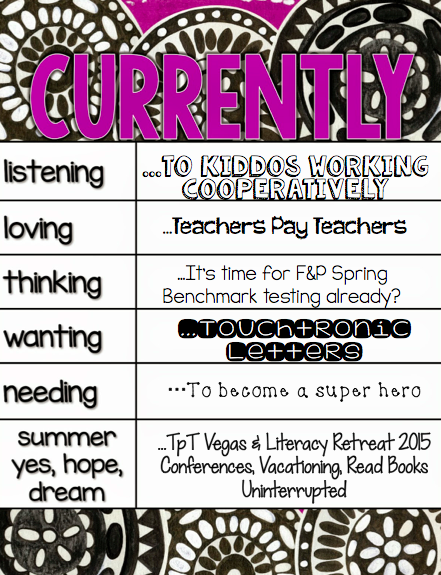
Listening: I take pleasure in listening to my students work collaboratively with one another while participating in word work activities.  They have come a long way since the beginning of the year.  I'm so impressed with their progress.  We've had fun reviewing blends and sight words this past week.  The kids love playing Pop for Blends to practice beginning blends.  I found the plate idea for word work on Pinterest. (You're the best, Pinterest!) :)
Loving: I love Teachers Pay Teachers.  My collection of goodies to support my Guided Reading groups sure has grown over the past few years, thanks to TpT.  I delight in creating TpT products for my students and sharing them with teachers, but when I don't have the time to create, I definitely support my fellow TpT sellers by spending, spending, spending.  I'm grateful for you, TpT sellers! Anyway, I've been trying to organize my baskets this week, and have come to the realization...I need more baskets and shelves!  (I haven't shown you my other shelves, since I'm still trying to organize those.)
Thinking: I can't believe it's time for the F&P Spring Benchmark Assessment already.  Our fantastic Literacy Coach, Courtney, prepared a testing schedule, as well as organized the F&P assessment boxes to pass out to the classroom teachers.  Starting next week, I will be joining Courtney and (my former blogging partner) Nancy, in assisting the teachers with the testing of 500+ students.  Benchmark testing, here we come! :)
Wanting: Ever heard of Junior Learning Touchtronic Letters?  I hope to acquire those for my little friends!  I'm seeing posts blowing up all over Social Media this past week.  I'm learning from teacher bloggers and Instagram friends how wonderful and engaging they are for students.  I think I am going to have to add those to my Amazon cart! 
Needing: (I'm needing Touchtronic Letters, but I'll pick a different one.) I'm needing to become a super hero.  Is that possible?  If I were a super hero, I'd be able to accomplish my want-to-do list in a fraction of the time it would take the average person.  I usually finish my to-do list filled with household chores in a timely manner, while my want-to-do list sits on the back burner (scorching itself).  One thing I want to do is read...uninterrupted ...for more than ten minutes per sitting.  I have many titles of professional books I desire to read.  I've purchased (and loved reading) Beyond Leveled Books and Teaching for Deep Comprehension.  

But recently?  My "wish list" of professional books has grown...very quickly.  Nonetheless, my time to sit down and read them is almost nonexistent.  
The reasons my time is almost nonexistent are ones I wouldn't change for the world.  I get to teach adorable kiddos all day and then get to come home to very sweet twin super heroes, as you probably already know if you follow my blog.  There doesn't seem to be room enough for one more super hero in our household right now.  I guess I'll put my decision to become a super hero on the back burner, too.  :)
Summer Yes, Hopes and Dreams: I certainly am looking forward to summer!  My YES is learning from professionals at the Literacy Retreat 2015 in June, and of course, experiencing TpT 2015 Conference in Vegas in July for the first time!!  I can't wait to meet some of my Social Media friends there!
My HOPE is to do lots of vacationing with my family in many various places around the states.  My DREAM is to read books uninterrupted for more than 10 minutes per sitting, as I mentioned above. ;)

Thanks to Kimberly Geswein for the fonts and to Farley for hosting another Currently!


Thinking About the Text: Using Textual Evidence When Responding to Reading- Freebie Included!


I'm linking up with Teaching Blog Addict for Freebie Friday to share my Thinking About the Text: Using Textual Evidence When Responding to Text freebie.  This is a *throwback* post I shared on Adventures in Literacy Land as a guest blogger, in case you missed it.  
As we all know, the Common Core State Standards declare students should be able to *read closely to determine what the text says explicitly and to make logical inferences from it* as well as *cite specific textual evidence when writing or speaking to support conclusions drawn from the text*.  That may be very difficult for students to do.  The majority of struggling readers and writers in my RtI groups often respond to their reading with brief, fragmented statements without text evidence supporting their thoughts.  Getting them to support an analysis of their reading with textual evidence takes much EXPLICIT guidance before they are able to be successful on an independent level.  

Students are not able to answer questions purely based off of their prior knowledge or personal experience.  Making personal connections to the text is still important, however, text-to-self connections are no longer a focus when responding to reading.  Students need to stay within the four corners of the text.  They need to carefully read and answer questions only referring explicitly to the text.  When discussing texts with my students, I pre-plan the direction I'd like to take them.  Under the proverbial umbrella of text-dependent evidence falls questions that can 1.) get to the general understanding or gist of the text 2.) be literal, but must also involve evaluation, synthesis and analysis and 3.) focus on particular vocabulary words, sentences, paragraphs, events and themes.  

When planning lessons to get my students to think more concretely about their reading, I often turn to K-2 Chart Sense: Common Sense Charts to Teach K-2 Informational Text and Literature and Chart Sense: Common Sense Charts to Teach 3-8 Informational Text and Literature.  I purchased these books at the tail end of last year and have not regretted it!  These books are fabulous and can really help guide teachers in implementing anchor chart visuals for students that encompass every reading standard.  Yes, anchor chart ideas for every Common Core reading standard, both informational text and literature, is addressed in these books!  Wow, right?
Below are some of the tools my students use, a text-evidence chart example taken directly from Chart Sense, pictures of my students using the chart and a brief description of the procedures I use with them. 
Behold the power of "Text-Evidence Detective Tools"! 
After much discussion, the students were asked to become *Text-Evidence Detectives*.  "Prove it with text evidence!" was a phrase they heard me say over and over again.   I gave them eye-lighters and magnifying glasses to locate the evidence for the first few go-arounds to get them excited for the hunt. ;)


For this particular activity, the students orally explained their thoughts and located text evidence to support them.  Because they were busy with the eye-lighters and magnifying glasses during this activity, I wrote their responses onto Post-It notes for the students to place on the chart.  Each day, we'd recap the previous day's notes as a review.  We'd then continue with our next text, using the previous day's notes as a reminder.  The various colored Post-It notes represent three texts read and discussed throughout the week. 

Since I work primarily with the texts in Fountas & Pinnell's Leveled Literacy Intervention kits which contain series of books, I also created anchor charts dedicated to the series' characters we often read about.  Some of the series within the F&P LLI kits include Moosling, Froggy, Fox Family and the Fix-It Family.  For this post, I chose to use our Moosling anchor chart as an example.
Since I can't claim to be an artist, I photocopied the cover of a Moosling book to place in the center of blank chart paper.  I then put "Moosling is..." and "Prove it with text-evidence!" at the top of the chart.   Easy enough, right? :)  Then, using a character trait poster, the students discussed possible traits Moosling possesses in the texts we've read thus far.  The students were given a few pre-read titles in the series to locate text evidence to support Moosling's traits.  They were responsible for writing down their evidence on the Post-It notes for this activity, so no "eye-lighters" or magnifying glasses were used during this part.  The students had a great time with this.  They took their job as "Text-Evidence Detectives" very seriously and were quite successful with it! :)  
After much guided practice my students were ready to test their skills independently!  For independent practice of citing textual evidence, I created a simple graphic organizer for my students to use, as well as a prompt poster for them to reference when responding to their reading.  You can see them in action below!
Student using the Textual Evidence Sentence Starters poster below
for her written response...

I created the organizer to mimic what we were doing together in a small group on the large chart paper, so it correlated with what they had been practicing.  My graphic organizer and prompt poster are FREEBIES, if you'd like to download them from my TPT store.  
My product includes black & white as well as color versions of both the graphic organizer and prompt poster.  I know teachers aren't always able to print in color. :)  

So, there you have it...a few simple and easy-to-implement ideas for your classroom to get students thinking inside the four corners of the text.  What are some ways you get students thinking about and citing from the text? 


Enjoy your day and don't forget to grab your freebie!


Related Posts Plugin for WordPress, Blogger...