Pages

Showing posts with label Academic Vocabulary. Show all posts

Literacy Retreat Session 5: Differentiating to Support English Language Learners

I'm glad you're back to learn more about the key ideas from Smekens Literacy Retreat.  I've been diligently working the past few weeks to get the last of my notes in order from the retreat, while still grasping the end of summer.  Once school mode kicks in full force, Sessions 6, 7 and 8 will be published!  If you would like to view the first four sessions in this mini-series, click HERE. :)

Session 5: Differentiating to Support English Language Learners
This session started out with a few laughs.  Since I attended the retreat in the Chicagoland area, the presenter, Kristi McCullough, began sharing a few terms that may get interpreted differently in Chicago by English language learners.  Below are a few of my favorites from Kristi's presentation.  If you're from Chicago, you may have experienced these firsthand! :)  Click the image to view the rest of the terms. 
We were then provided with a little background on WIDA.  WIDA is a partnership of US state departments of education that develops learning standards for English language learners (ELLs).  Students can't just sit in the corner doing a puzzle while the others, for example, learn about the life cycle.  We were told 250 minutes of embedded learning in a new language is required, which means all teachers need to embed strategies within content instruction in order for students to fulfill the 250 minutes.  Teachers should not wait to teach kids content until they have learned English.  We have to continue to teach ELLs in the content areas as they progress in English. 

Examine an English Language Learner:
ELLs progress through stages to grasp the English language, starting with listening, then moving on to speaking, reading and writing.  ELLs are not necessarily starting from square one in the language department.  They can be highly diverse and have a variety of background experiences.  ELLs may have some academic language, but struggle having a conversation. On the other hand, ELLs may struggle with academic language, but can comfortably uphold a conversation with others.  They must perceive their talking, reading and writing in a new language as meaningful.  It is imperative learning a new language be rooted in a variety of meaningful discussions, which teachers can provide in their classrooms.  

We all know it is not plausible for teachers to learn every language that may enter their classrooms, but all teachers play a critical role in supporting the language development of ELLs.  Students can greatly benefit from teachers who learn about ELLs' home cultures, value their linguistic diversity and acquire instructional approaches to support them.  We can not solely rely on ESL teachers to support ELLs, so here are a handful of ways mainstream teachers can support them:
  • Focus on a set of academic vocabulary
  • Use multiple modalities
  • Teach independent strategies
  • Integrate oral and written instruction
  • Utilize menor texts (Smekens Education 2015)
Teach a Set of Academic Vocabulary Intensively:
It was recommended at the retreat, teachers choose vocabulary-building texts for students to use.  The texts should have the ability to connect to units of study happening in the classroom.  Texts that can be discussed from a variety of perspectives are also important.  NewsELA is a wonderful, FREE online resource students can use to locate current news articles.  The site provides texts that are brief, interesting and engaging for students.
Source
McCullough mentioned it's important the texts contain a variety of academic words to target and have enough detail and examples to ensure comprehension.  The Vocab Determinator was provided at the retreat as a way to determine academic words crucial for students to learn. 
Once academic words have been determined with the support of The Vocab Determinator, teachers should introduce them with the following 4-Step format:
Introduce an Academic Word in 4 Steps: 
Teacher-led Introduction
  1. Teacher explains a word in simplistic terms using prompts, such as Someone who...Something that...
  2. Teacher ties the word to an example relevant to the students
  3. Teacher connects it to the text
  4. Students explain the word to a partner with Turn & Talk (Smekens Education 2015)
Use Multiple Modalities to Teach Vocabulary: 
Concept sorts are powerful ways to introduce vocabulary.  They are used before reading a text and can be done with individuals, small groups or in a whole class setting.  Concept sorts allow students the opportunity to have repeated practice with vocabulary terms.  They help students better grasp the meaning of the terms because the terms are being placed into categories based on meaning.  Students can also sort important details from content areas, such as terms, pictures, text features and quotes from a text.  The following video clip was suggested at the retreat.  It demonstrates a worthwhile activity called List-Group-Label.  
Games, such as HedBandz, along with Apps like Charades! Kids and Heads Up!, are also suggested as fun activities to get kids talking and discussing terms.  One of my favorites that was not mentioned at the retreat, but is still engaging and entertaining, is Educational Insights Blurt.
If you would rather create your own game, try Headbands (teacher-made version), using the instructions and variations below.  Students can ask questions or act out and guess vocabulary words of your choice.  Using KitzKikz, a FREE card-generating site, can help you quickly create vocabulary questions cards for your students when playing Headbands! 

Teach Independent Word-Learning Strategies: Context Clues
Students need to be taught to look "inside" a word to solve new words for meaning, in addition to "outside" the word for context clues.  "Educators who choose to teach roots leverage word parts creating opportunities for students to grow their vocabularies exponentially.  Each root a student acquires can lead to the understanding of twenty or more English words (Rasinski, Padak, Newton & Newton, 2008).
Here are some tips to try:
  • Look "inside" the word, using the bike analogy.
  • Teach cognates!  Cognates are words from two languages that are the same or similar.  Check out Colorin Colorado for more information on cognates.  Ex: family/familia 
  • Look "outside" the word by seeking text features, glossary, rest of sentence, etc. to decipher a word's meaning.
The presenter compiled a list of Greek and Latin word parts to teach students.  If you click HERE, you'll find the list which includes beginning and advanced prefixes, suffixes and base words, and, most importantly, the top word list for English language learners. Rootle is a game that can be used with students to teach Greek and Latin word parts. 
***To play the game, student-pairs reach into a container and select 4 root-words. They write those roots at the top of the Rootle handout. Then pairs race to generate as many words in the left column as they can that contain one or more of the roots.  Students can race against each other--first team to fill up all the lines wins. Or, they can race against the clock--the team with the most points at the end of a time limit wins. (Smekens Education 2015)

Integrate Oral and Written Instruction: Comprehensible Input (Stephen Krashen)
What is Comprehensible Input?  It's language input that can be understood by listeners despite them not understanding all of the words and structures in it.  Below is a quick video from Krashen himself explaining Comprehensible Input.  Sit back because we're going "old school" in this video.  Even though the video is from the 1980s, it's still very informative.  You'll see what it is like to be an ELL.  
Here are the instructional tools teachers can use so students can acquire Comprehensible Input:
  • Speak a little slower, not louder! :)
  • Speak in phrases
  • Combine auditory with print
  • Use visuals- gestures, pictures, realia
  • Combine with graphic organizers
  • Explain with short videos  
Furthermore, it is recommended to put ELLs together in small groups, so they can use their home language to clear up confusing parts of a lesson.  Do not always put ELLs with students who have English as their home language.  Have them read class material on their own first, then talk with a partner to make the input comprehensible. Make sense?

Utilize Mentor Texts:
Teachers should "build background knowledge about figures of speech by using mentor text with visuals and references of how the term was first used...{and} increase the volume of known words by teaching synonyms and antonyms." (Smekens Education 2015)  Below are a few of the suggested mentor text titles to support ELLs. We were told these texts are useful for writing Haiku poetry and word association lists.  If you're looking for another online resource, Read Write Think has an interactive Haiku activity for students to use.
At the end of the session, the book, Teaching for Comprehending and Fluency: Thinking, Talking and Writing About Reading, K-8, was recommended by McCullough.  In the book, I. Fountas & G.S. Pinnell state: Students need to see themselves represented in books they hear, read aloud, read for themselves, and discuss with one another (p.502)." 
After McCullough shared this quote, she then provided a multi-cultural book list for educators to use as a reference guide to locate titles for the classroom.  Click the image to download a copy of the list for yourself.


Overall, the strategies mentioned in this post are beneficial for all students, not just ELLs.  However, they are critical for ELLs!  What are some other ways you might support the English language learners in your classroom?

Thanks for stopping by Literacy Loving Gals to learn how to better support students.  The next session in this mini-series is Inferring Ideas from Visuals & Multimodal Texts and will be coming soon!  Stay tuned.  :)


Literacy Retreat, Session 4 Recap: Teaching Academic Vocabulary with Six Interactive Strategies

Let the Literacy Retreat mini-series continue!  If you are interested in reading about the previous sessions from the retreat, click HERE.  

Session 4: Teaching Academic Vocabulary with Six Interactive Strategies
The session began with Courtney Gordon, the presenter, sharing some research findings with us.  Acknowledging the research at the start of the session enabled the attendees to better understand the significance of teaching students strategies to improve their academic vocabulary, or better yet, the consequences if we don't.   Students knowing and understanding vocabulary words in a text is key to their comprehension.  

Acknowledge the Research:
  • Vocabulary is among the greatest predictors of reading comprehension (Baker, Simmons, and Kameenul), and reading comprehension is central to learning in the content areas. (Fischer & Frey)
  • Researchers estimated that for students in grades 4-12, a 6,000 word gap separated students at the 25th and 50th percentile. (Nagy & Herman)
  • Students need to know 96% or more of the words within any given text to comprehend its message. (Robb)
  • Simply being well-read does not cause students to learn vocabulary as deeply as they need to.  Direct vocabulary instruction is necessary! (McKeown)
  • A robust approach to vocabulary instruction involves directly explaining the meanings of words and providing thought-provoking, playful, and interactive follow-up. (Beck, McKeown & Kucan)
  • The number of exposures to a word is key.  It can take upwards of 40 exposures to a word for a struggling and at-risk student to really understand, own and master a word. 
Those findings are thought-provoking, to say the least.  Have you ever heard of the 4-14-40 research from Robert J. Marzano?  I learned of it years back when taking courses for my ESL Endorsement.  The last bullet point in the research above is part of the 4-14-40 research.  If you are unfamiliar, it can be explained as follows:
The highest-achieving students can learn a new term with as few as 4 exposures to it.  The average student needs to work with a word up to 14 times in order to master it.  And your most struggling learners need as many as 40 different opportunities to work with a single word to finally learn it. (Smekens Education 2015)
Can you believe it?  40 exposures to a word is what it takes for some students to learn a single word.  Marzano's six interactive vocabulary strategies can help close that astonishing word gap mentioned in the research findings.  The strategies are Explain, Restate, Show, Develop, Refine and Play.  There is a power to the order of the steps!  

Gordon explained the pacing of these six steps using phases.  Steps 1, 2 and 3 happen in approximately one week, which is known as the Initial Understanding Phase.  In this phase, students are just trying to gain a foundational understanding of a word.  Steps 4, 5 and 6 take the rest of school year and can not be rushed. This is known as the Shape and Sharpen Phase.  During this phase, students are given plenty of opportunities to dig deeper to really acquire a thorough understanding of a word.  The Vocabulary Notebook and the Digital Vocabulary Notebook (Yes, paperless!!) resources below were given as tools for students to use as an ongoing resource to help them obtain 40 exposures to a term.  Click to download the notebooks for your students! 

Approximately 30 words per subject per year is ideal for students to internalize.  These should be considered "core academic vocabulary", or high-utility words.  Many additional words can and, most likely, will be taught to the students, but the core words are what would get the most attention.  Teachers need to figure out which words are viewed to be crucial for students' understanding of each subject area.  Once you determine the words that will be explicitly taught, begin Marzano's six interactive strategies. 

STEP 1: EXPLAIN
The first step is all about the teacher and how he/she explains terms to the students.  Students require hearing an informal definition of a word presented in kid-friendly terms first.  Warning: Try not to use adult-language.  Students also need to be given a link or connection between the word and the students' background knowledge. Connections are made using relevant examples, such as: 
  • Life experiences
  • Stories, anecdotes
  • Scenarios, hypothetical situations
  • Visuals, videos, 
  • Real-life objects
  • Current events
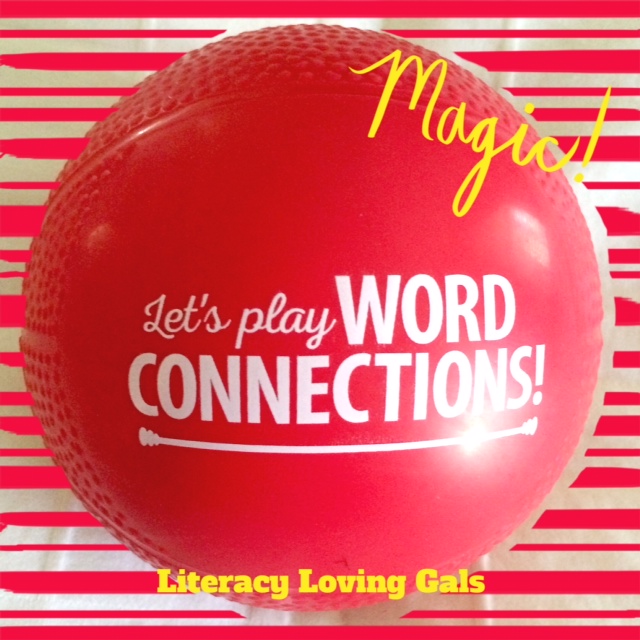
A strategy called "Let's Make Connections" can be used during this step when introducing a new term (as well as during Step 6: Play).  Students sit in a close-knit circle making as many connections to a word as they can while gently tossing a ball back and forth to one another.  We were told this ball is like *magic* because students can't wait to get their hands on it and share their connections.  It's always top-notch when kids are motivated to participate!  All of the attendees received a "Let's Make Connections" ball at the retreat.  I can't wait to put mine to good use with my students.
STEP 2: RESTATE
Students start to progress in their understanding of a word in Step 2.  They are required to demonstrate their understanding by restating it in their own words.  Students can use sentence stems for support.  Here are some examples:
  • It is something...
  • It is someone...
  • It describes...
  • It is a concept...
  • It is the idea that...
  • It explains...
Another suggested activity for this step is to have students rewrite the lyrics to a popular children's song (Twinkle, Twinkle Little Star, Mary Had a Little Lamb, etc.) to explain a term.  For example, using the tune Twinkle, Twinkle Little Star, a student may explain the term "boulder" like this: "Boulder Boulder big, big rock"...and so on.  

I must say, there were tons of giggles and outright bursts of laughter coming from the tables all around me at the retreat.  We were asked to create lyrics to explain a term picked from a baggie.  Trying to make up lyrics to reiterate the meaning of a term to a particular beat can be quite hysterical, actually.  I am not musically-inclined...at all.  I think that's why I married a musician.  I was hoping his lyrically gifted tendencies would rub off on me.  That hasn't happened.  It was fun making a slight fool of myself at the retreat and was a wonderful learning experience.  I bet my students would have a blast doing this activity, just as I did.  The student instructions are as follows:

STUDENT INSTRUCTIONS
1. Listen to the tune of [chosen song title}.
2. Generate a list of related words and phrases for your term.
3. Arrange and rearrange the words and phrases to convey the terms meaning and fit the rhythm/rhyme of the song. 
(Smekens Education 2015)

If students prefer to have a freestyle beat (upper-elementary through high-schoolers, maybe?), use this suggested tune found on YouTube.  If you have the time, pick a term and try it for yourself using the beat below! :)

STEP 3: SHOW
Students show in a non-linguistic representation the meaning of a word by using abstract tools.  Visuals help cement academic vocabulary into a student's memory.  Some methods to have your students use are: 
  • Identify, find or select images that represent the word
  • Reveal a physical object that represents the word
  • Illustrate meaning by drawing an object, an example, graphic, etc.
  • Act out the meaning of the word
  • Create a physical or digital model to represent the word's meanings
You can access free resources all over the Internet, including these suggested sites, Photo Flashcards and InsideStory Flashcards.  Students can manipulate play-dough for a more kinesthetic approach, too.  Below is a handout from Smekens Education you may find useful.
STEP 4: DEVELOP
Students develop a deeper understanding of a word when they apply it in multiple contexts.  Based on Marzano's 4-14-40 research, students should have the opportunity to create additional vocabulary activities to deepen their understanding.  Try using the following activities with your students:
  • Identify synonyms & antonyms
  • Define root meanings (prefix, base, suffix)
  • List, sort & classify related words
  • Note similarities and differences to other words
  • Identify common confusions and misunderstandings
  • Write or draw analogies
Wordle is a free online tool that generates word collages.  This resource can support students' vocabulary development in a fun way. A recommended activity is to have students create a Wordle for a specific vocabulary term using descriptive language.  Then have classmates take turns guessing the vocabulary word based on the clues given in the Wordle.  Below is a student's example given to us at the retreat.  Can you guess what the student was describing?  
STEP 5: REFINE
Students use peer interactions to express their thinking, appreciate different perspectives and develop their overall understanding of a word.  Teachers need to make sure to offer many social opportunities in the classroom for students to discuss terms in pairs, small groups and as a whole class.  Students' conversations should focus on:
  • Explanations & restatements
  • New examples
  • Newly learned information or "A-ha!" moments
  • Areas of confusion or disagreement
I'm sure you've seen this scenario over and over again...students pick the same partners every...single...time and the same kids are the talkers, while others just sit and listen.  The listeners are usually the shy students or the ones just "taking it all in".  Right?  Well, to encourage participation from everyone, teachers could use Clock Buddies.  Students are given a clock image on paper.  They each place their name in the center of the clock and their peers names in different hour slots around the clock.  The teacher calls out, for example, "For this activity, you'll be working with your 2 o'clock buddy (buddies)."  It's a cute idea and simple enough to implement in your classroom tomorrow!  Click the image below to download the example and a master copy for yourself.
STEP 6: PLAY
This last step is game-like to promote vocabulary knowledge.  Once students are able to truly understand a group of terms, they can cement their learning through play.  The activities need to be kept face-paced to help move recall from deliberate to automatic!  Games can either be low-pressure or intense competition.  We were told, Hangman is a spelling game, not a vocabulary game!  However, the following are good examples of games students can play:
  • Vo-BACK-ulary (Teacher-Created Game: Tape a vocabulary term on a student's back.  The student walks around the room while peers give clues to what the term is- similar to Hedbanz)
  • Who am I?
  • Hedbanz
  • Jeopardy
  • Taboo
At the end of this session, I walked out a minute early to get some water and heard my name being called.  I quickly scurried back in to find out my name was pulled from the raffle bowl!  I won the Hedbanz game and can't wait to use it with my kiddos. ;)
Academic Vocabulary and Testing: Where are we headed?
The video called Increase Test Success with Academic Vocabulary was shared with us at the Literacy Retreat.  It shows Krista Smekens explaining how to better prepare students for more complex words that tend to be within test questions.  Further resources to support academic vocabulary are below. Click on them to download a copy for yourself. :)


If you are looking for a book recommendation, check out Marzano's book Building Background Knowledge for Academic Achievement: Research on What Works in Schools. Courtney Gordon referenced it as a useful resource for teachers looking to promote the academic success of students needing vocabulary support.  We were told this book nicely merges research and classroom application. 
Thanks for stopping by Literacy Loving Gals to learn more about supporting your students' academic vocabulary growth.  Your students will thank you.  Check back to view the next topic in this mini-seriesSession 5: Differentiating to Support English Language Learners.  It will be coming soon! :)
Related Posts Plugin for WordPress, Blogger...