Pages

Showing posts with label Scholastic. Show all posts

Sneak Peek into "The Coaching Partnership: Collaboration for Systematic Change"

Coaching. It's quite a dynamic role. Being a coach might be uncomfortable and demanding at times. However, it can be pleasurable and gratifying, too. Even though I've just begun my 24th year as an educator, and have an abundance of strategies in my teacher tool belt when working with children, I must declare, when it comes to the world of *teaching adults*, I'm a newbie. 

For numerous years, I've dabbled in supporting adults in a variety of ways, such as supervising student-teachers and mentoring new staff. However, my role as a Literacy Coach for the past (going on) three years has been an entirely unique journey. There have been an abundance of impactful ups, alongside a smattering of setbacks. If I am being honest, mistakes have been made and situations have been approached in a semi-regrettable manner. I say "semi-regrettable" because we all need to endure difficult times to come out stronger in the long run. I guess that's pretty much life, though. Nonetheless, I have learned from all of my experiences and have witnessed some tremendous growth on my end. Tons of self-reflection happening over here!

Apart from having a bit of experience in this role, as well as a Literacy Coach team like no other, another undertaking that has helped me jump start my impact as a coach is reading professional texts. If you were to peruse my blog, you'd see an assortment of posts highlighting some of those texts, many of them being books published by Scholastic. 

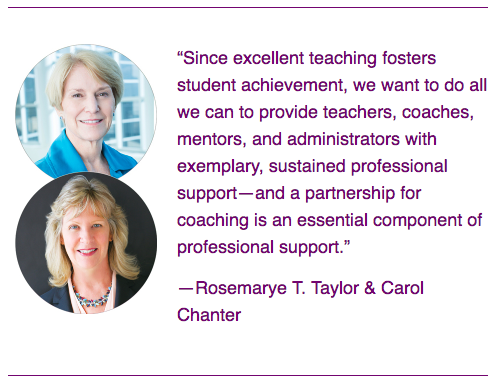
My latest read is The Coaching Partnership: Collaboration for Systematic Change by Rosemarye T. Taylor and Carol Chanter. This book is packed with comprehensive tips and suggestions to guide change-agents in increasing student achievement. I've highlighted and tagged much of the book's contents, which support collaboration, inquiry, generative thinking, communication strategies, delivery modes, self-reflection, and, of course, on-going learning.
For my "sneak peek" posts, I usually reveal what's in the Table of Contents. Look below and you'll see the book is divided into three parts: Part 1: Learning Partners, Part 2: Learning Process, and Part 3: Learning Breakthroughs. Within these three parts, you'll find real-life vignettes called From the Field that are accompanied by Questions for Reflection to support professional reflection on the readers' end. You'll also come across suggested supplemental resources riddled throughout its pages referencing useful coaching blogs and other professional book titles supporting coaching partnerships, as well as links to self-assessment surveys to encourage additional learning.  

If you're anything like me, you may find it helpful to view videos of coaches in action or coaching gurus sharing advice. This book provides readers with an online, password protected site containing videos and downloadable resources. Below are images of what the site has to offer. It provides all the tools you'll require to  better help you optimize and implement the coaching partnership system. 

For "sneak peek" posts, I also enjoy sharing tips or advice I've highlighted directly from the book that have served me well. It is my hope to give you better insight into The Coaching Partnership: Collaboration for Systematic Change. I definitely recommend the book!
  • A feeling of continuous growth is a wonderful source of motivation and confidence (p.12).
  • Administrators determine the value given to coaching and mentoring in their schools (p.13).
  • The intent is for each person in the learning partnership to be empowered to improve the outcomes of the partnership (p.24).
  • Having a well-thought-out focus for coaching can help target and achieved desired outcomes (p.29).
  • If adult learning is valued, then administrators will find ways to carve out time for opportunities for teachers to observe each other, discuss learning, and analyze student evidence of learning (p.37).
  • To overcome barriers or negative experiences, in-person meetings are almost always recommended over email, if only for the frequency with which emails can be misunderstood (p.62).
  • In the coaching partnership, all are equal in asking for, receiving and giving coaching and feedback (p.63).
  • To facilitate authentic discussions that build rapport and trust, we suggest replacing the common "Any questions?" with "Jot down your wonders" (p.66).
  • In contrast to norms in school cultures, norms of collaboration are deliberately developed and agreed to. Norms foster collaboration, build relationships, and help avoid interactions that may derail the learning process (p.71).
  • The power of coaching is this--you are expected to give people the path to find answers, not the answers (p.83).
  • Whether coaching groups or individuals, learn how to take people through the steps of identifying a problem of practices, setting learning goals, learning, gathering and analyzing evidence, reflecting, and refining practice. This sophisticated skill of moving adult learners along a continuum of instructional expertise is the heart and soul of the coaching role (p.95).
  • An expert is someone who knows some of the worst mistakes that can be made in his subject, and how to avoid them (p.100).
  • Leaders are those who empower others (p.120).
If you're interested in snagging a free copy of your own, drop a comment below to be entered in a giveaway. :) 

Happy Coaching!


Reading Revealed: 50 Expert Teachers Share What They Do and Why They Do It~ Sneak Peek!

Diane Stephens, Jerome C. Harste, and Jean Anne Clyde joined forces, alongside a nifty fifty expert teachers, to write Reading Revealed: 50 Expert Teachers Share What They Do and Why They Do ItIn the Introduction, Diane Stephens states, This book is based on the premise that no matter how long we have been teaching, no matter how good we are as teachers, we can always do a better job tomorrow than we did today (p.11). So true! As a Reading Specialist and Literacy Coach, I am always seeking manageable ways to continue learning, growing and improving as an educator in order to support student growth in all areas of literacy. 
If you were to peek into the Table of Contents, you'd notice four parts, Part I: Knowing Reading, Part II: Knowing Readers, Part III: Engaging Readers, and Part IV: Knowing the Language to Usewhich include thirty eight *engagements*, or instruction and assessment actions to engage students in a variety of ways, such as Reading Interviews, Book Clubs, Strategy Sharing, Written Conversations, Class Journals, and more.
Each *engagement* provides a Why? (advantages), Who? (those who may benefit), How? (materials needed & step-by-step procedures), Closure/Stepping Back (conclusion), and How's It Going? Informal Assessment section to support educators in diving deeper into its implementation. Examples of student work, classroom vignettes, photographs, and more are also displayed throughout the pages. The *engagements* can be implemented straightaway because they are well organized and explicitly explained. 
Furthermore, the book provides readers with an online, password-protected site containing videos and downloadable resources that accompany the *engagements*. Below are images of what the site has to offer. 


For this post, I also wanted to highlight some quotes and tips taken directly from the book to give you better insight into Reading Revealed: 50 Expert Teachers Share What They Do and Why They Do It.
  • The authors show the deep, intentional thinking that all students can engage in when their teachers understand that comprehension is the end-all and be-all of reading, and when they understand that reading must always make sense and sound like language (or it's not reading) (p.9).
  • In the hands of expert, responsive teachers who have fingertip access to classroom and school libraries brimming with beautiful books that kids want to read- and who know reading, know their students, and know how to engage them- all children will discover the joy and power of reading (p.10).


  • As you learn, share what you know and, as you bring the ideas of others into your classrooms, make your ideas become parts of other people's classrooms (p.18).
  • Teachers who are kidwatchers understand their students as people, which makes it possible to plan more responsively, see more clearly, and appreciate students in ways that percentages and letter grades simply don't allow (p.30).
  • It would be hard for students to learn that reading is about meaning-making if, in school, reading is about getting the words right (p.82).
  • Independent reading works when we create a context in which the focus is on meaning, students are reading books they want to read and with which they feel successful, and students consider reading to be pleasurable (p.84).
  • As students become more experienced in talking about books, you can help them develop and awareness of the power of conversation by asking, "What did you learn about reading and what readers do from talking about books?" (p.135).
  • We strongly believe that teachers need to know kids and get kids engaged with books- two responsibilities that work hand-in-hand (p.224). 
  • We learn the most about kids when they are engaged (p.224).
  • No matter the size of the group, we need to get to know our students and identify their strengths and needs (p.224).
Thanks for taking a sneak peek. Leave a thoughtful comment for a chance to win a copy of the book for yourself!  :)


Sneak Peek into "From Striving to Thriving Writers: Strategies That Jump-Start Writing" (& Giveaway!)

I've been a huge fan of Stephanie Harvey for many years. It all started with her book, Strategies That Work: Teaching Comprehension for Understanding and Engagement. Since then, she's among a handful of literacy gurus I admire and closely follow to gain perspective from and to become better equipped in best and next literacy practices. Last year, I read her (and Annie Ward's) book, From Striving to Thriving: How to Grow Confident, Capable Readers and raved about their suggestion to *table the labels* to empower children to grow as readers. 

When I got wind of a new Striving to Thriving professional text hitting the shelves, I was interested in taking a peek. I learned much from the first book dedicated to striving readers, including more on the complexities of language learning, but I also had many personal beliefs validated. When my copy of From Striving to Thriving Writers: Strategies That Jump-Start Writing arrived, I was instantly able to see its value.

Stephanie Harvey, Sara Holbrook and Michael Salinger joined forces to write the book. On page 6, it states, This book is about helping our students harness the power of language to accomplish their own purposes for writing: to tell a story, to investigate an issue, to prioritize information, to persuade a reader, and to generally inform. 

If you were to peek into the Table of Contents, you'd notice 27 writing frameworks designed to differentiate for and support striving writers, as well as to improve and integrate writing across the curriculum. The frameworks are divided into three parts: Learning About Language, Learning Through Language, and Using Language to Learn About Self
Each framework provides a suggested starting grade-level (Kindergarten through 6th and up) and focus skills. For example, the first three frameworks listed in the picture below are for 'Kindergarten and up': Picture This, Refrain Again, and Scaffolding Into Sharing. Depending on the framework, the focus skills covered may include Persuasive, Descriptive, Research, Vocabulary, and Figurative Language. Take note of Sara Holbrook's tweet below about the grade level suggestions for the frameworks. Teachers know their students best! :)
In order for students to become better equipped writers, they need to write... A LOT...and OFTEN. Voluminous writing is the key to moving writers forward. Holbrook and Salinger discuss 3 ways to support writing in volume: 1. Embed writing in all content areas. 2. Pre-write to get it right. 3. Take it one version at a time. Click HERE to learn more.
The book provides readers with an online, password-protected site that includes downloadable resources available to help educators support students with voluminous writing. The resources include graphic organizers ("GO sheets") for students to use during the pre-writing stages, as well as professional videos of the writing frameworks in action to view firsthand. Having these resources at the tip of our fingers can allow the frameworks to be implemented straightaway. The videos allow readers flexible opportunities to grow professionally, even while at home! Below are a handful of screenshots depicting the online resource site. 


The authors caution in their tweets below that GO sheets are not worksheets, but engaging and valuable outlines for students!  
Below is a peek into the first framework: Sentence Variety Pack: Crafting Engaging Text. You can get a better sense of what the book offers, including online slides to support implementation of the framework, lesson extension ideas, sample stages of students' writting and assessment checkpoint rubrics. Jackpot! 
There is so much more to the book than I've briefly overviewed. I look forward to putting these frameworks into practice with students in the upcoming weeks. I highly recommend you snagging a copy for yourself! Additionally, there's a blog post written by Larry Ferlazzo in Education Teacher Week titled Writing Frames Are The Recipes of Writing. Within the post, Holbrook and Salinger answer the following questionHow can we use "writing frames" and "writing structures" without students feeling like they always have to do formulaic writing? If their response interests you, click HERE to read more. 

Leave a relevant comment below for a chance to acquire a free copy for yourself! :)
P.S. Check out the authors on Twitter, @saraholbrook, @michaelsalinger, and @Stephharvey49, as well as the content linked to the hashtag #FromStrivingtoThrivingWriters! They're visible and welcoming!


Happy Writing & Happy Thanksgiving! 


Related Posts Plugin for WordPress, Blogger...