Pages

Showing posts with label Prompting. Show all posts

"Preventing Misguided Reading: New Strategies for Guided Reading Teachers" by Burkins & Croft

Reflection, reflection, reflection. I have grown a great deal as a professional educator over the past 21 years, first as a classroom teacher and now as a Reading Specialist. I've taken risks, made mistakes, failed, as well as succeeded, through trial-and-error attempts within my instruction. After diving into the book, Who's Doing the Work? How to Say Less So Your Readers Can Do More by Burkins and Yaris last summer, I became better enlightened in effective practices for the next generation of guided reading instruction. That book truly altered my perception of what quality guided reading instruction should look like. I wrote a post dedicated to Who's Doing the Work?, so if you're interested in reading it, click HERE.
When I heard Burkins, the co-author of Who's Doing the Work?, had co-authored another book dedicated to guided reading, I quickly logged into Amazon and purchased Preventing Misguided Reading: New Strategies for Guided Reading TeachersFor this post, I simply want to highlight some of the authors' thoughts, but as you can see from the Table of Contents below, the book is jammed packed with worthwhile content. There are 6 chapters, each clarifying a misunderstanding about guided reading. The chapters are then broken down into 27 strategies that further support teachers with their guided reading practices. 
When I first started teaching, Fountas and Pinnell were my foundation for teaching reading. Over the years, I've added to my professional reading shelf, but the *yellowing copy* of my first guided reading book still remains. Fountas and Pinnell introduced guided reading back in the 1990's, but somehow, what they intended for teachers has transformed into something quite different. 
However, Burkins and Croft aim to clear up this unintended transformation and the confusion surrounding guided reading. This book helps empower teachers to refine their instruction and helps students become proficient readers. Below are quotes taken from their book. 
  • Education is littered with the remains of educational trends lost in translation. Often, the reality is that we compromise fidelity of their implementation (p.xv).
  • In many cases, guided reading has become prescriptive and regimented, even though guided reading lessons should be responsive to the needs of particular groups of readers, because sound reading instruction is all about knowing how individual students interact with text (p.xvii).
  • ...Fountas and Pinnell (1996) explain that 'the purpose of guided reading is to enable children to use and develop strategies "on the run" (p.xvii).'
  • In terms of guided reading, we believe there is merit in adjusting some of our practices for the sake of preserving an instructional model that focuses on reading processes rather than discrete reading skills (p. xix). 
  • Educators tend to use the  terms 'guided reading' and 'small-group reading' interchangeably. Small-group reading instruction, however, is often not guided reading. Small- group reading instruction may also be shared reading, word work practice, read-aloud, and so forth (p.xxi).
  • Guided reading is not really about levels, benchmark texts, or offering the right prompts to students when they struggle with words. Rather, guided reading is, for us, about supporting students as they develop strategic approaches to meaning making (p.xxi).
  • Students' processes will vary across texts, so a student may demonstrate a balanced reading process in one text and a print dependence in a more difficult text (p.7).
  • Our destination is reading independence (p.11).
  • ...if we teach students to let the text support them, we foster more independence in students. In order to do this, we can teach students to rely on the text rather than on the teacher for scaffolding (p.12).
  • In the simplicity of the daily read-aloud resides a powerful tool that defines and depicts the role of the reader and the act of reading (p.13).
  • We want students to understand from the very first day of shared reading that the act of reading is story driven, or, more simply, an act of discovering what the author is telling us (p.15).
  • The direct teaching of skills and strategies should largely occur outside of guided reading (p.16).
  • We believe that connecting instruction across modeled, shared, guided, and independent reading allows teachers to gradually shift to the students the responsibility for the literacy work (p.18).
  • ...scaffolding has evolved into helping, which we sometimes offer through extensive and specific prompting. We can instead engage read-aloud, shared reading, guided reading, and independent reading to systematically scaffold students as they learn how to help themselves (p.27-28).
  • Rethinking our guided reading structures within the gradual release of responsibility can give us more flexibility, more success, and less frustration (p.28).
  • ...we find ourselves working for "wonders", or digging for "treasures", when students are in texts that are too difficult for them. Their success rests on our support, or our effort, rather than their independence (p.31).
  • [Allington] further states that "many, many students are confronted daily by texts tat are too complex for optimal learning". In contrast, many educators believe that, in instructional-level texts, "the difficulty of the text and tasks needs to be beyond the level at which the student is already capable of independent functioning [Tyner] (.32)."
  • If guided reading is beyond student skill levels, how then can they take these skills into independence? (p.32).
  • Most important in terms of text selection, the guided reading book must be manageable for the readers (p.47).
  • By giving students texts they can manage, we nurture and solidify their abilities to integrate and consolidate various sources of information efficiently and practice the smoothly operating system that is the bedrock of learning to read (p.47).
  • The idea that readers move in precise ways through neatly defined stages and levels, and that they progress through these levels in systematic, chronological order, does not fit with what we have seen of beginning readers. In fact, Clay (1991) writes, "Fluctuations in performance, large leaps forward, movements backward in text difficulty to consolidate or recapitulate are movements to be expected under satisfactory conditions of instruction" (p.55).
  • Again, learning to read is less about level and more about the reading process (p.65).
  • We need to teach even our youngest students to think of reading as meaning making and to act on texts in sophisticated ways to access these meanings (p.70).
  • The more you support students' understanding of cross-checking through modeled and shared contexts, the more you are likely to see students cross-check in guided reading (p.85). 
  • We find the power of learning to administer running records (and IRIs) invaluable to informing instructional decisions... (p104).
For more information, I highly recommend reading the book. You can also take a peek at the resources below that accompany the information in Preventing Misguided Reading. Just click on the images to download your own copies of the resources! 
I hope you found the information in this post helpful. Thanks for stopping by and have a great weekend!

P.S. You can't go wrong when the author thanks you on Twitter for the post. See? This is why I love Jan Miller Burkins' so much. XO





My Favorite Quotes from "Who's Doing the Work?" by Burkins & Yaris

While on Twitter, I came across an image titled "Ladder Questions for Reading Conferences" via @BurkinsandYarisAs a Reading Specialist, I was instantly intrigued, of course.
After perusing the Twitter feed connected with the image, I quickly became hooked on the content Jan Burkins and Kim Yaris share regarding something known as *Next Generation Reading Instruction*. I realized these talented ladies are authors of various books, including Who's Doing the Work? How to Say Less So Readers Can Do More. I purchased a copy straightaway via Amazon and was on pins and needles waiting for my book to arrive in the mail! During the waiting period, I had sneak-peeks of the book's content via tweets from my PLN. #ilovemyPLN 
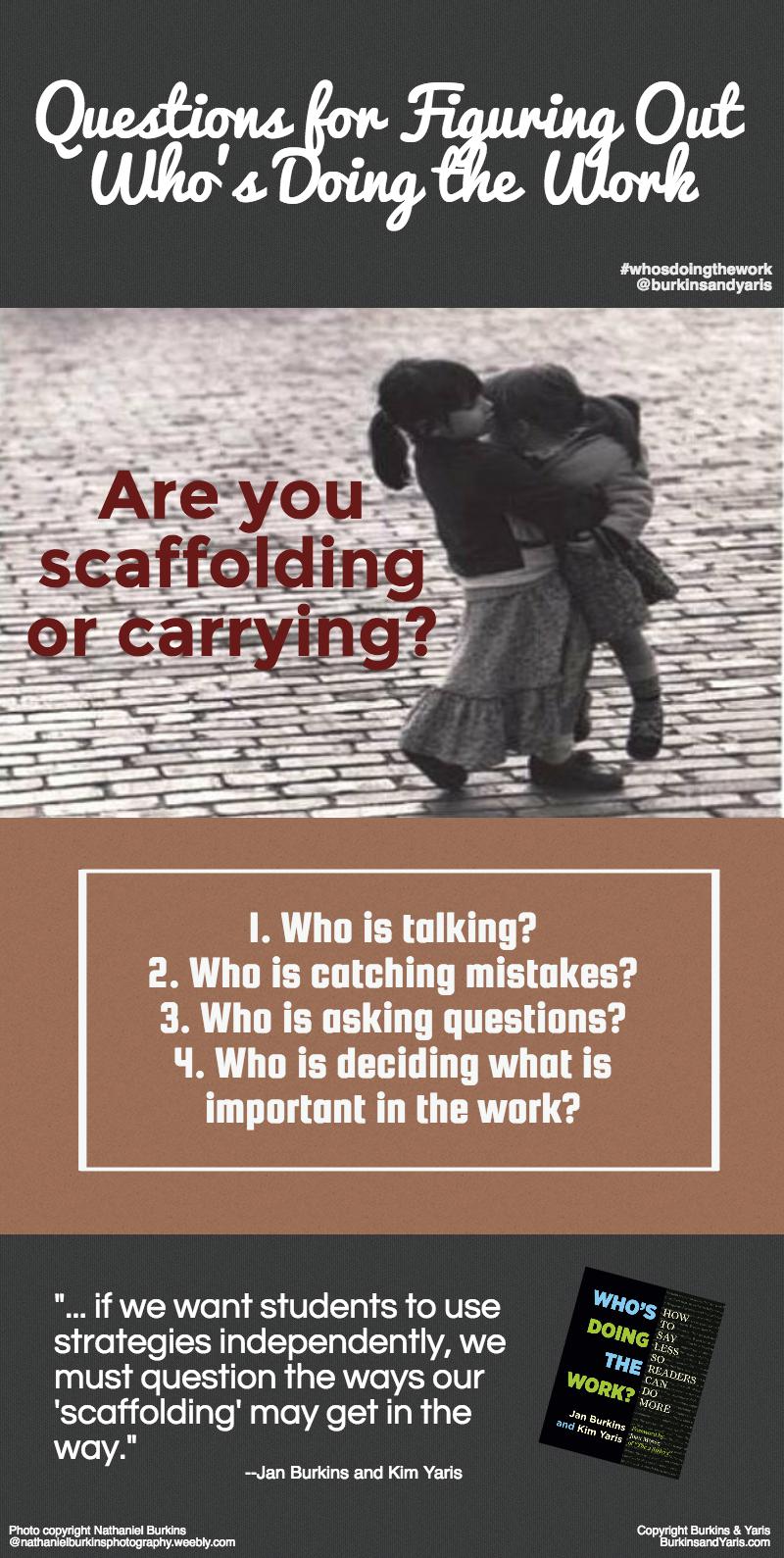
This book has certainly modified my views on how to support (and NOT support) readers, especially those who struggle. Unbeknownst, teachers may actually be causing what we know as *learned helplessness* in students by over-scaffolding during guided reading. Are you scaffolding or carrying? To figure out who's doing the work during guided reading, ask yourself:

  1. Who is talking?
  2. Who is catching mistakes?
  3. Who is asking questions?
  4. Who is deciding what is important in the work?

For this post, I simply want to highlight some of my favorite quotes/tips from the book to give any teacher who teaches reading to students another perspective on the forthcoming way to instruct students in reading. 
  •  "Provide Scaffolding" has been education's blanket answer to many of the most complex teaching and learning situations (p.3). 
  • Similarly, education's current approach to scaffolding readers supports students in ways that eliminate much, if not all, of the decision making for them (p.5).
  •  ...we too often develop readers who know how to practice isolated strategies- question, infer, synthesize, clarify, and so on- but who aren't reading for the deepest meaning of a text or reading for the love of it (p.7).
  • Rather than teach children to preview texts, we take on the introductions. Rather than teach them to wonder and notice, we ask them text-dependent questions. Rather than allow students to truly choose books for themselves, we retain control, confining them to narrow reading-level parameters and placing excessive demands for book logs and written reflection (p.13).
  •  To grow and develop as readers, children need instruction that mirrors the "end" goal- readers with smoothly operating, balanced reading processes who feel empowered and motivated to take charge of their reading lives (p.24).
  • Teaching across the gradual release of responsibility with an emphasis on reading process- versus an emphasis on reading level- will change the way you teach reading forever (p.27).
  • Read-aloud is a commercial for learning to read (p.30).  
  •  When children, particularly those who are not reading at grade level, receive little or no shared reading practice, moving up to the next reading level is often too big a leap for them to make because they have no exposure to the texts they are growing into next. This can cause guided reading groups to plateau as students get stuck in a level (p.57-58).
  •  Shared reading encourages a growth mindset (p.58). 
  •  Shared reading helps children progress faster in guided reading (p.58). 
  • As much as possible, use think-pair-share to give all students opportunities to think deeply about what they are discovering in the text (p.63). 
  • Get into the text quickly. Don't spend much time setting it up; let the book do the work. Remember, you want to begin with the end in mind, and no one will introduce the text in independent reading (p.73).  
  •  When selecting a text for guided reading, it is tempting to simply match the text level to the current level of the students in the group, but next generation guided reading instruction is a bit more discerning and takes into consideration the particular needs, interests, and reading processes of the students in the group (p.89). 
  •  Next generation guided reading should look as much like independent reading as possible because on the gradual release of responsibility, guided reading is just one step removed from independent reading (p.91). 
  •  Give children time to solve problems before prompting them. Enough time often feels like too much time (p.99). 
  •  Next generation guided reading involves less guiding and more responsive following (p.100).
For more information, check out the authors' blog. It's filled with amazing insight into next generation reading instruction, including how to *peel your banana differently* in guided reading! 


Last but not least, let's hope this is true!!


Thanks for stopping by and have a happy weekend! :)

Literacy Retreat, Session 4 Recap: Teaching Academic Vocabulary with Six Interactive Strategies

Let the Literacy Retreat mini-series continue!  If you are interested in reading about the previous sessions from the retreat, click HERE.  

Session 4: Teaching Academic Vocabulary with Six Interactive Strategies
The session began with Courtney Gordon, the presenter, sharing some research findings with us.  Acknowledging the research at the start of the session enabled the attendees to better understand the significance of teaching students strategies to improve their academic vocabulary, or better yet, the consequences if we don't.   Students knowing and understanding vocabulary words in a text is key to their comprehension.  

Acknowledge the Research:
  • Vocabulary is among the greatest predictors of reading comprehension (Baker, Simmons, and Kameenul), and reading comprehension is central to learning in the content areas. (Fischer & Frey)
  • Researchers estimated that for students in grades 4-12, a 6,000 word gap separated students at the 25th and 50th percentile. (Nagy & Herman)
  • Students need to know 96% or more of the words within any given text to comprehend its message. (Robb)
  • Simply being well-read does not cause students to learn vocabulary as deeply as they need to.  Direct vocabulary instruction is necessary! (McKeown)
  • A robust approach to vocabulary instruction involves directly explaining the meanings of words and providing thought-provoking, playful, and interactive follow-up. (Beck, McKeown & Kucan)
  • The number of exposures to a word is key.  It can take upwards of 40 exposures to a word for a struggling and at-risk student to really understand, own and master a word. 
Those findings are thought-provoking, to say the least.  Have you ever heard of the 4-14-40 research from Robert J. Marzano?  I learned of it years back when taking courses for my ESL Endorsement.  The last bullet point in the research above is part of the 4-14-40 research.  If you are unfamiliar, it can be explained as follows:
The highest-achieving students can learn a new term with as few as 4 exposures to it.  The average student needs to work with a word up to 14 times in order to master it.  And your most struggling learners need as many as 40 different opportunities to work with a single word to finally learn it. (Smekens Education 2015)
Can you believe it?  40 exposures to a word is what it takes for some students to learn a single word.  Marzano's six interactive vocabulary strategies can help close that astonishing word gap mentioned in the research findings.  The strategies are Explain, Restate, Show, Develop, Refine and Play.  There is a power to the order of the steps!  

Gordon explained the pacing of these six steps using phases.  Steps 1, 2 and 3 happen in approximately one week, which is known as the Initial Understanding Phase.  In this phase, students are just trying to gain a foundational understanding of a word.  Steps 4, 5 and 6 take the rest of school year and can not be rushed. This is known as the Shape and Sharpen Phase.  During this phase, students are given plenty of opportunities to dig deeper to really acquire a thorough understanding of a word.  The Vocabulary Notebook and the Digital Vocabulary Notebook (Yes, paperless!!) resources below were given as tools for students to use as an ongoing resource to help them obtain 40 exposures to a term.  Click to download the notebooks for your students! 

Approximately 30 words per subject per year is ideal for students to internalize.  These should be considered "core academic vocabulary", or high-utility words.  Many additional words can and, most likely, will be taught to the students, but the core words are what would get the most attention.  Teachers need to figure out which words are viewed to be crucial for students' understanding of each subject area.  Once you determine the words that will be explicitly taught, begin Marzano's six interactive strategies. 

STEP 1: EXPLAIN
The first step is all about the teacher and how he/she explains terms to the students.  Students require hearing an informal definition of a word presented in kid-friendly terms first.  Warning: Try not to use adult-language.  Students also need to be given a link or connection between the word and the students' background knowledge. Connections are made using relevant examples, such as: 
  • Life experiences
  • Stories, anecdotes
  • Scenarios, hypothetical situations
  • Visuals, videos, 
  • Real-life objects
  • Current events
A strategy called "Let's Make Connections" can be used during this step when introducing a new term (as well as during Step 6: Play).  Students sit in a close-knit circle making as many connections to a word as they can while gently tossing a ball back and forth to one another.  We were told this ball is like *magic* because students can't wait to get their hands on it and share their connections.  It's always top-notch when kids are motivated to participate!  All of the attendees received a "Let's Make Connections" ball at the retreat.  I can't wait to put mine to good use with my students.
STEP 2: RESTATE
Students start to progress in their understanding of a word in Step 2.  They are required to demonstrate their understanding by restating it in their own words.  Students can use sentence stems for support.  Here are some examples:
  • It is something...
  • It is someone...
  • It describes...
  • It is a concept...
  • It is the idea that...
  • It explains...
Another suggested activity for this step is to have students rewrite the lyrics to a popular children's song (Twinkle, Twinkle Little Star, Mary Had a Little Lamb, etc.) to explain a term.  For example, using the tune Twinkle, Twinkle Little Star, a student may explain the term "boulder" like this: "Boulder Boulder big, big rock"...and so on.  

I must say, there were tons of giggles and outright bursts of laughter coming from the tables all around me at the retreat.  We were asked to create lyrics to explain a term picked from a baggie.  Trying to make up lyrics to reiterate the meaning of a term to a particular beat can be quite hysterical, actually.  I am not musically-inclined...at all.  I think that's why I married a musician.  I was hoping his lyrically gifted tendencies would rub off on me.  That hasn't happened.  It was fun making a slight fool of myself at the retreat and was a wonderful learning experience.  I bet my students would have a blast doing this activity, just as I did.  The student instructions are as follows:

STUDENT INSTRUCTIONS
1. Listen to the tune of [chosen song title}.
2. Generate a list of related words and phrases for your term.
3. Arrange and rearrange the words and phrases to convey the terms meaning and fit the rhythm/rhyme of the song. 
(Smekens Education 2015)

If students prefer to have a freestyle beat (upper-elementary through high-schoolers, maybe?), use this suggested tune found on YouTube.  If you have the time, pick a term and try it for yourself using the beat below! :)

STEP 3: SHOW
Students show in a non-linguistic representation the meaning of a word by using abstract tools.  Visuals help cement academic vocabulary into a student's memory.  Some methods to have your students use are: 
  • Identify, find or select images that represent the word
  • Reveal a physical object that represents the word
  • Illustrate meaning by drawing an object, an example, graphic, etc.
  • Act out the meaning of the word
  • Create a physical or digital model to represent the word's meanings
You can access free resources all over the Internet, including these suggested sites, Photo Flashcards and InsideStory Flashcards.  Students can manipulate play-dough for a more kinesthetic approach, too.  Below is a handout from Smekens Education you may find useful.
STEP 4: DEVELOP
Students develop a deeper understanding of a word when they apply it in multiple contexts.  Based on Marzano's 4-14-40 research, students should have the opportunity to create additional vocabulary activities to deepen their understanding.  Try using the following activities with your students:
  • Identify synonyms & antonyms
  • Define root meanings (prefix, base, suffix)
  • List, sort & classify related words
  • Note similarities and differences to other words
  • Identify common confusions and misunderstandings
  • Write or draw analogies
Wordle is a free online tool that generates word collages.  This resource can support students' vocabulary development in a fun way. A recommended activity is to have students create a Wordle for a specific vocabulary term using descriptive language.  Then have classmates take turns guessing the vocabulary word based on the clues given in the Wordle.  Below is a student's example given to us at the retreat.  Can you guess what the student was describing?  
STEP 5: REFINE
Students use peer interactions to express their thinking, appreciate different perspectives and develop their overall understanding of a word.  Teachers need to make sure to offer many social opportunities in the classroom for students to discuss terms in pairs, small groups and as a whole class.  Students' conversations should focus on:
  • Explanations & restatements
  • New examples
  • Newly learned information or "A-ha!" moments
  • Areas of confusion or disagreement
I'm sure you've seen this scenario over and over again...students pick the same partners every...single...time and the same kids are the talkers, while others just sit and listen.  The listeners are usually the shy students or the ones just "taking it all in".  Right?  Well, to encourage participation from everyone, teachers could use Clock Buddies.  Students are given a clock image on paper.  They each place their name in the center of the clock and their peers names in different hour slots around the clock.  The teacher calls out, for example, "For this activity, you'll be working with your 2 o'clock buddy (buddies)."  It's a cute idea and simple enough to implement in your classroom tomorrow!  Click the image below to download the example and a master copy for yourself.
STEP 6: PLAY
This last step is game-like to promote vocabulary knowledge.  Once students are able to truly understand a group of terms, they can cement their learning through play.  The activities need to be kept face-paced to help move recall from deliberate to automatic!  Games can either be low-pressure or intense competition.  We were told, Hangman is a spelling game, not a vocabulary game!  However, the following are good examples of games students can play:
  • Vo-BACK-ulary (Teacher-Created Game: Tape a vocabulary term on a student's back.  The student walks around the room while peers give clues to what the term is- similar to Hedbanz)
  • Who am I?
  • Hedbanz
  • Jeopardy
  • Taboo
At the end of this session, I walked out a minute early to get some water and heard my name being called.  I quickly scurried back in to find out my name was pulled from the raffle bowl!  I won the Hedbanz game and can't wait to use it with my kiddos. ;)
Academic Vocabulary and Testing: Where are we headed?
The video called Increase Test Success with Academic Vocabulary was shared with us at the Literacy Retreat.  It shows Krista Smekens explaining how to better prepare students for more complex words that tend to be within test questions.  Further resources to support academic vocabulary are below. Click on them to download a copy for yourself. :)


If you are looking for a book recommendation, check out Marzano's book Building Background Knowledge for Academic Achievement: Research on What Works in Schools. Courtney Gordon referenced it as a useful resource for teachers looking to promote the academic success of students needing vocabulary support.  We were told this book nicely merges research and classroom application. 
Thanks for stopping by Literacy Loving Gals to learn more about supporting your students' academic vocabulary growth.  Your students will thank you.  Check back to view the next topic in this mini-seriesSession 5: Differentiating to Support English Language Learners.  It will be coming soon! :)

The Book Study Has Begun! The Reading Strategies Book: Goal 1- Supporting Pre-Emergent and Emergent Readers

Welcome to the book study on Jennifer Serravallo's The Reading Strategies Book: Your Everything Guide to Developing Skilled Readers presented by the #ReadingStrategiesCrew!  Since this is not a typical book, think of it more as a *strategy discovery* study.  I am joining forces with fabulous teacher bloggers to discuss reading strategies from this amazing professional text.  We are thrilled to share our thoughts on this comprehensive and practical book including 300 sensational, easy-to-implement reading strategies for students in grades Kindergarten through 8th Grade.

Each teacher blogger in the #ReadingStrategiesCrew will give you a peek into one of the 13 goals represented in this text.  Within each goal are, of course, valuable strategies to support your ability to prompt and guide students to deepen their skills as readers.  Because it supports such a wide range of readers, teachers can also guide students to more complex texts throughout the year with these strategies! 

The #ReadingStrategiesCrew decided we would each share 2 to 3 strategies within our selected goal, so please keep in mind I'm only highlighting a few strategies my goal has to offer.  We're hoping to spark thoughts on a plan of action for the start of your school year. 

I'm kicking off the study by saying Jennifer Serravallo is awe-inspiring.  She started her educational career as a classroom teacher and has become, in my eyes, one of the most genius literacy consultants and authors out there.  She states on the very first page, "The strategies I've crafted in this book stand on the shoulders of decades of research and master teachers from whose work I've been fortunate to learn...I feel grateful to be part of a profession where there is so much sharing and commingling of thinking..."
Let's get started with Goal 1: Supporting Pre-Emergent and Emergent Readers.  There are twenty strategies within this goal to support pre-emergent and emergent readers.   Below is a snapshot of the strategies reinforcing this goal.  The format of Serravallo's *literacy bible* {in my terms} is not necessarily a front cover to back cover type of read, but more of a handy guidebook of sorts.  Serravallo compared it to a cookbook of recipes.  The format allows teachers to pick and choose from research-based strategies that will best scaffold students, just as a cook would pick and choose recipes from a cookbook.   
  
For each strategy, Serravallo includes a description of the strategy and helpful prompts to use with students.  Many of the strategies also provide Teacher Tips and samples of Lesson Language to use when putting the strategy into practice.  The strategies can be demonstrated to individuals, small group or whole class.  In addition, along the sidebar of each strategy, Serravallo indicates the level (pre-emergent to Levels R and above), genre/text type and skill(s) in which to focus.  I find these to be invaluable features of the book because even a novice or experienced classroom teacher without a reading background can fully support and guide their students in reading.  This book elicits powerful reading instruction! 

The 3 strategies I will be discussing are Linger FingerExpress the Emotions and Keep in Mind What Repeats.  It was very difficult to narrow in on only 3 strategies to discuss.  Once you own the book, you'll understand why. :) In view of the fact I work with struggling readers and oftentimes encounter students rushing through their books, reading in a monotone voice and taking the time to sound out words that continuously repeat in a text, I chose these particular strategies.  

Have you ever heard a student say, "I can't read"?  I'm sure you're nodding your head up and down, especially if you work with the younger student population in the pre-emergent and emergent stages of reading.  Well, Serravallo has been convinced by various researchers that "We can meet students where they are and help them engage with and enjoy books, make meaning, acquire vocabulary, use text features to understand, connect the pages, respond to the texts by writing and talking, practice their fluency, and perhaps above all, develop identities as confident, engaged, joyful readers {even without decoding} (p.21)".  Agree?  I bet you're nodding your head up and down again. 
Focus Strategy One: Linger Finger  
The Linger Finger strategy focuses on noticing details.  It encourages students to slow down and deliberately inspect, if you will, all the details a text has to offer.  I regularly stimulate conversations with my students discussing how books offer wonderful illustrations, text features and other *goodies* for readers to appreciate, be entertained by and learn from.  Too often my youngest readers rush through their books, only to shout, "I'm done!"  If you've encountered this same scenario in your classroom, you should consider implementing this strategy with your students.  Below is a simple anchor chart found in Serravallo's book to create with your students as a reminder to take it slow, or linger, while reading.  This anchor chart along with the catchy title for this strategy are a nice *hook & sinker* for students to remember to take their time while reading. 
To get a better sense of the Linger Finger strategy, here are a few ideal prompts found in the book: 
  • Move your finger across the page.  Tell me what you see.
  • Not so fast!  Stay on the page a moment.
  • You went across the whole page and said sentences about what you saw!
  • What will you do before you turn the page? (p.26)
Focus Strategy Two: Express the Emotions
The Express the Emotions strategy develops fluency and expressive reading.  It provokes students to think about how a character in a story may be feeling and then asks students to use a voice to sound like the character.  This strategy is very practical and easy to implement.  It triggered memories of particular kiddos I've worked with in the past.  Most likely, we've all encountered a few students who sound as if they're robots while reading...those who utter words on the page in a tiresome, monotone voice, almost as if they are reading while sleeping.  Yes?

Serravallo's teaching tip for this strategy is to model fluent, expressive reading in various parts of a book to show students a myriad of emotions present in a text and to help students tap into their inner actor (p.31).  I love that phrase because we know little actors and actresses can develop in all of our readers. :) Serravallo also mentions students who are not yet decoding can still make meaning from illustrations and expressively *read* the pictures.  The anchor chart below can be created in the classroom during a mini-lesson and serves as a reminder for students to read with expression.
For the Express the Emotions strategy, Serravallo suggests using prompts such as these: 
  • How did the character say that?  Show me.
  • Say it thinking about how the character is feeling.
  • I could tell he sounded happy (or mad or sad) because of how you read that.
Focus Strategy Three: 
Keep in Mind What Repeats
The Keep in Mind What Repeats strategy fosters students to be text detectives by finding repeated patterns in a text, together with noticing what parts are new on each page.  Brown Bear, Brown Bear, Chicka Chicka Boom Boom and We're Going on a Bear Hunt were cited as appropriate books to use with this strategy.  They each include parts that repeat alongside parts that change on the page.  When students become more mindful of repeated patterns while reading, they'll become more fluent, and we all know fluency aides comprehension.  Therefore, being mindful helps them better monitor for meaning.  Note the anchor chart below as an example of one teachers could create with their students in the classroom. 
The prompts found in the book for the Keep in Mind What Repeats strategy are
  • What's the same on this page?
  • Say what repeats.
  • Check the picture to see what's new.
  • How is this page different from the last?
  • How is this page similar to the last?
You may be asking yourself, "What books do I use to support the students working on this goal?"  Well, Serravallo contemplated that, too.  I'm here to assure you, she thought of EVERYTHING while writing this book.  EV-ER-Y-THING!  Serravallo's suggested criteria for books helpful in supporting pre-emergent and emergent students are as follows:
  • texts that are visually engaging
  • stories that have a strong narrative with recognizable dialogue, and some repetition
  • informational texts that offer opportunities to learn content from the photographs and other features
  • list books with clearly supportive pictures
  • alphabet and number books to help reinforce knowledge of letters and sounds and numerals connected to a number of objects (p.22)
I'm hoping I gave you helpful insight into a few strategies found in Goal 1: Supporting Pre-Emergent and Emergent Readers.  After diving into this text and reflecting back on my own teaching instruction, I came to the realization I implement many of the strategies already.  I bet you do, too!  The strategies I discussed probably sound familiar to ones you've implemented with your students.  However, I think having a name/title for each strategy and a goal in which the strategy reinforces will definitely aid me in keeping organized and focused during my lesson planning.  

Looking ahead to this school year, I intend to implement oodles of strategies from The Reading Strategies BookThere are 300 strategies to choose from, therefore I need to use this book as "a menu not a meal".  I heard that saying many years back at a Reading First conference.  It stuck with me as a reminder to choose what works best for my students and me.  There is no need to use every single strategy if the situation doesn't call for it.  Right?

Serravallo states, "An ideal classroom is one in which every student has a clear goal, based on reliable formative assessment information." Because of this, my course of action is to continue observing and conferring with my students, writing detailed notes and deciding which direction to take my instruction to move them forward as dynamic, independent readers.  I'm eager to use Serravallo's book as a GO-TO resource filled with dog-eared, highlighted, tabbed and marked pages to remind myself of these worthwhile strategies.  I deem this a mentor text for any teacher involved in teaching reading to students! 
Image Source- Lori Squalls created this image and was happy to share.  
Thanks, Lori!  If you're looking for a good Twitter follow, check her out! 
In case you're interested, last year I created the activity below to provide a simple, yet, fun way for my students to practice reading dialogue expressively.  It seems to nicely complement the Express the Emotions strategy.  Click the image if you would like to view it in my TpT Store. 
Before you go, enter the Giveaway for a chance to win a copy of Jennifer Serravallo's The Reading Strategies Book: Your Everything Guide to Developing Skilled Readers!  Entries will be taken until the end of the day on August 17th.  A winner will be announced on August 19th, so stay tuned!
a Rafflecopter giveaway
The #ReadingStrategiesCrew would also love for you to share your thoughts in the comments section or link up your own blog post below.  The link up will remain open in case you don't have the book, yet, and want to write a post in the future. :)

Questions to Consider:
  • As you plan your lessons, what might be some ways you prepare yourself to support pre-emergent and emergent readers in your classroom?
  • What do you want to be mindful of when working with readers needing support with this goal?
  • If you do not teach pre-emergent and emergent readers, how can you apply your knowledge of these strategies with your developing readers?
Well, thanks for stopping by Literacy Loving Gals to kick off the book study!  As the study continues in the upcoming weeks, the hyperlinks to each teacher blogger's post will be added below to help keep the goals organized in one spot.  We hope you continue to follow along with us! :)
  1. Literacy Loving Gals: Goal 1 Supporting Pre-Emergent and Emergent Readers
  2. My First Grade Happy Place: Goal 2 Teaching Reading Engagement
  3. The Literacy Spot: Goal 3 Supporting Print Work
  4. EduKate Dawson: Goal 4 Teaching Fluency
  5. Love to Teach A Latte: Goal 5 Supporting Comprehension in Fiction~ Plot and Setting
  6. An Apple for the Teacher: Goal 6 Supporting Comprehension in Fiction~ Thinking About Characters
  7. Owl Things First: Goal 7 Supporting Comprehension in Fiction~ Understanding Themes and Ideas
  8. Inspire Me ASAP: Goal 8 Supporting Comprehension in Nonfiction~ Determining Main Topic(s) and Idea(s)
  9. Beginnings with Baer: Goal 9 Supporting Comprehension in Nonfiction~ Determining Key Details
  10. Mrs. B's First Grade: Goal 10 Supporting Comprehension in Nonfiction~ Getting the Most from Text Features
  11. I'm Not Just a Teacher: Goal 11 Improving Comprehension in Fiction and Nonfiction~ Understanding Vocabulary and Figurative Language
  12. Digital Divide & Conquer: Goal 12 Supporting Students' Conversations
  13. Where the Magic Happens: Goal 13 Improving Writing About Reading


Related Posts Plugin for WordPress, Blogger...