Pages

Showing posts with label Mentor Texts. Show all posts

A Glance into "Responsive Literacy: A Comprehensive Framework"

This book is glorious! When my copy of Responsive Literacy: A Comprehensive Framework arrived in the mail, I was happily surprised to see an abundance of vividly colored photographs depicting real classrooms spread across the pages. The authentic examples of anchor charts and student work allow readers to better experience the components of the comprehensive literacy framework more closely. 
Responsive Literacy is backed by decades of research and practice. It was written by literacy leaders affiliated with The Ohio State University Literacy Collaborative, alongside the amazing Patricia L. Scharer as Editor. On page 10, it states, Our goal was to create a reader-friendly book brimming with illustrative photographs, easy-to-navigate charts, and essential understandings to support professional learning and student achievement. The book is geared toward K-6 teachers as a way to increase the effectiveness of literacy instruction, but could easily be expanded to the middle grades.
Check out the topics in the Table of Contents to get a better sense of what this book provides. Take notice of the educational leaders that contributed to the contents of this book. Gay Su Pinnell is among them.
As you've probably noticed by the Table of Contents, the book is divided into six sections containing the essential ingredients of responsive literacy: Professional LearningOrganizing for LearningReadingWritingBuilding Blocks of Language, and A Learning Community. Each section delves deeper into topics, such as the complexities of the language learning, organizational practices for reading, writing and word study, and developing a learning community encompassing students, staff and families.

I have many favorite aspects of this book. One being the mentor text suggestions. The book references an abundance of mentor texts  correlating to lesson examples or ways to implement the texts in the classroom. Another aspect I find helpful is the teacher-student dialogue examples, consisting of ways to support students during writing conferences, for example. 
 

Furthermore, the book provides readers with an online, password protected site that includes videos of Writing and Reading Workshop Elements with transcripts for all of the videos, in addition to downloadable resources. Below you'll find screenshots of what the site offers. Having access to the site allows readers flexible opportunities to grow professionally, even while at home in pajamas. #mytimePD #myfavorite

As a Literacy Coach and Reading Specialist, I love all things literacy. I feel this book highly promotes enjoyable reading, writing, speaking and listening experiences for students. It's definitely a new favorite I'll be referring back to when planning for literacy instruction and staff development. If you are a literacy leader, a classroom teacher, and even part of an administration team in the field of Education, I highly recommend this book. 

Scholastic never ceases to amaze me with their ability to continually publish invaluable literature to better equip educators with the knowledge necessary to support students. Before you go, read some quotes found on Twitter highlighting the book. Thank you, Scholastic!


Happy Reading!


Literacy Retreat Session 8: Using Mentor Texts to Teach Sentence Variety

Welcome to the last post in the Smekens Literacy Retreat mini-series.  I learned so much at the retreat this past summer and truly hope I have the opportunity to attend each year.  The presenters were knowledgeable and entertaining, while the giveaways were impressive.  I won a vocabulary board game for my students and was given tons of amazing and useful freebies for my classroom.  I can't say enough great things about Smekens.  In case you missed the previous posts in this mini-series, click HERE or choose a particular session below. :)
  1. Achieving Complex Thinking During Reading
  2. Executing Complex Tasks After Reading
  3. Building Stronger Beginnings and Endings
  4. Teaching Academic Vocabulary with Six Interactive Strategies
  5. Differentiating to Support English Language Learners
  6. Inferring Ideas from Visuals & Multimodal Texts
  7. Revitalizing the Writing Process
  8. Using Mentor Texts to Teach Sentence Variety 
Before I jump into using mentor texts to teach sentence variety, I wanted to share my excitement.  I recently attended and presented at the Illinois Reading Council Conference in Peoria and bumped into Krista Smekens, the presenter from the Smekens Literacy Retreat! What a nice surprise.  She's so fabulous! :)
Session 8: Using Mentor Texts to Teach Sentence Variety 
The number one reason a text is deemed complex is its length and structure of sentences, not its ideas, so finding mentor texts to teach sentence variety is the first step.  Krista Smekens stated, "Anything you can use and learn from are considered mentor texts.  So many books have a voice or style that is helpful to teach concepts, especially sentence variety."  The book The Writing Thief by Ruth Culham was recommended at the retreat. 
It provides insight into the specific skills needed to attain sentence variety, the contributors that make sentences just plain *sound better* to the reader, over 90 titles of excellent mentor texts and activity ideas to incorporate the traits of writing across narrative and informational types of writing.

After the discussion of The Writing Thief, a group of helpers began walking around to the tables dropping off a blue package marked *DO NOT Open~ We'll tell you when..." to each of the attendees.  Oooh, I must say we were all very intrigued and couldn't wait to break the seal on the package. ;) 
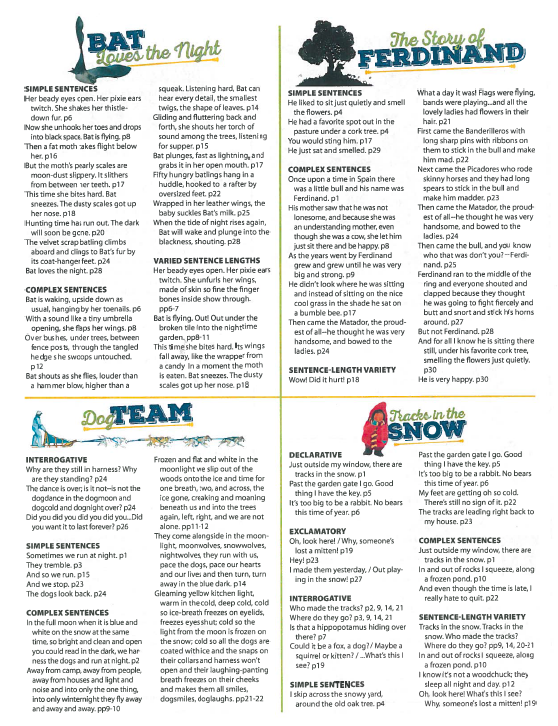
Once we were able to open the package, we found the *Top Four* recommended mentor texts to help teach students about sentence variety.  Curious?  Drumroll, please...They are: Bats Love the NightDogteamThe Story of Ferdinand and Tracks in the Snow. We were given these as freebies.  Do you see how fantastically awesome the freebies were at the retreat?  Anyway, these four texts help support students in creating well-built sentences and varying sentence patterns. 
We then talked about the criteria for what makes a sentence, ways to get students familiar with the different types of sentences, along with a few mini-lesson ideas, and overall sentence fluency, using the four mentor texts above.

Define a Sentence: What is the criteria for a sentence?
It is pertinent for teachers to define the term *sentence* for students.  This should always be the first step in the process to learning sentence variety.  As you know, a sentence has a subject and a verb and is a complete thought.  This is not obvious to students! Students need to learn how to strip a sentence down to its core~ the subject and the verb.  It is crucial for students to know just because words are grouped together in a book doesn't mean it is a complete sentence.  Teachers should also clarify for students what a complete thought looks like.  

Ways to Get Students Familiar With Different Types of Sentences:
Below are some ideas for students to practice becoming familiar with the different types of sentences.  The suggested mentor texts for the introduction of a defining a sentence are Dogteam and Bats Love the Night
  • Two-Word Sentence Search: As a follow-up activity to Sentence Smackdown, have the students go on a two-word sentence search.  Create an anchor chart of subject/verb sentences that have passed the Sentence Smackdown, which means sentences that have a subject and verb.  Note from the presenter: Exclude dialogue from the hunt, but don't limit the search to literature/fiction. 
  • Comma Woes: After students practice with more simplistic sentences, teachers should then begin to explicitly teach the use of commas in sentences.  There are 20 different applications for the use of commas in sentences.  
The presenter commented, "Although students learned what a sentence was in the primary grades, as they get older, they tend to regress."   Jeff Anderson, the author of Mechanically Inclined: Building Grammar, Usage and Style in the Writer's Workshop, attributes this to the fact their writing skills aren't keeping up with their growing ability to express more complex thoughts.  He claims, "This explains why so many write run-on sentences.  And for those trying to utilize the comma, they often misuse it."  

Varied Sentence Length: As readers, we need sentence lengths to vary.  Writing expert, Ralph Fletcher, says "Without it writing is a mind-numbing sameness.  When sentences are all approximately the same length, it dulls the reader's senses."  So, to get students to practice writing sentences of varying lengths, try the activity below.
  • Wooden Block Towers: Have students build *tower sentences*.  If the tower crashes, it's most likely a run-on sentence.  Ask the students, "Are your towers different sizes?"
  • The Slinky Test: Students can assess the variety of sentence usage in a piece of writing by extending and shortening a slinky while reading their sentences.  The point is to have a compressed Slinky and a stretched Slinky to show sentence variety. Warning: Unless you explicitly teach students not to play with the slinky, this may be better for more mature kids.  However, I'm here to tell you, my 2nd and 3rd grade students composed sentences in their writing journals and took The Slinky Test with no issues. :)


Mini-Lesson Ideas:
Take the time to discuss with students the appropriate writing situations when they should use exclamation points, onomatopoeia, an excited or angry voice, etc., and then let kids experience punctuation! 
  • Punctuation Walk-About: Have students adjust their physical body to *hear* punctuation.  Boys especially love this activity!  It helps with self-editing as well. 
  • Punctuation Clap-About: The goal is for students to put the correct punctuation in the first draft.  Have them *act out* their sentences.
Now let's move on to overall sentence fluency.  This is all about teaching students to craft sentences to fit a particular writing purpose and to *break the rules* for impact.  Here are some examples of rule breakers:
RULE BREAKERS:
  • Intentional fragments to show panic, emphasize a phrase or reiterate something
  • One-word sentences, such as abrupt interjections, onomatopoeia, periods between every word to force the reader to notice every word
  • And & But beginnings to show important contrasts or connections and to avoid confusion.
Narrative Sentence Fluency:
When students have mastered what a sentence is, it becomes about the undercurrent of the message.  Sentence length impacts the mood!  
If the author is trying to convey something urgent, sentences are short and quick.  Teach students to break up a long sentence into short, quick sentences.  Prompt them with, "Which one sounds better?", "How does it sound?"  Examples are below. 
Then, do the opposite and have students fine fast-intense-urgent sentences and make them longer to create a slow-calm-relaxed feeling for the reader.
Informative Sentence Fluency:
Because sentence length impacts the message, students need to use longer sentences to explain ideas and shorter sentences to grab the reader's attention.  There are good examples in the text Bats Love the Night.


Here are some tips shared at the retreat:


Finally, introduce dialogue because, when students write stories, those characters are going to start talking.  Teach students to use fragmented phrases in dialogue.  According to Smekens, it is what happens in real life.  That's usually how we speak when having conversations with friends.  Try having students use speech bubbles to practice dialogue at first, then move on to quotation marks within a piece of writing.  Ever heard of WigFlip online speech bubbles?  If not, take a peek. 

Dictation Apps and Websites:
If you're looking to enhance your mini-lessons with additional tech ideas, the following suggestions were discussed as being useful.  I am only familiar with Dragon Dictation and have yet to look into the other resources, but I will! :)

  1. Dragon Dictation App (tutorial HERE) or dictation.io (tutorial HERE) allows students to dictate a story.  Text appears but no punctuation, unless students say aloud what punctuation they need.  For example, nowadays, you can text message someone with audio commands, but in order to have question marks, you need to say "question mark" after your questions.  Have kids practice placing punctuation in their text.
  2. Voice Assistant App: This is similar to Dragon Dictation. Click HERE for more information.
  3. www.grammar-monster.com was recommended for upper elementary students.  According to Smekens, this site provides online practice to support students in finding stand-alone sentences and allows them to view highlighted independent clauses with the dependent clauses left blank.  
Well, that's all for now!  I hope you found the information in this post useful.  Enjoy!

Literacy Retreat Session 6: Inferring Ideas from Visual and Multimodal Texts

Well, my summer vacation has ended.  Even though I will miss the warm days on the beach and at the lake house, as well as camping with my family, I'm ready to start another school year.  I can't believe this will be year 20 for me in education.  Boy, time flies.  Below is Session 6 from my Literacy Retreat mini-series which began earlier this summer.  If you would like to read about the first 5 sessions, click HERE to access them.  

Session 6: Inferring Ideas from Visual and Multimodal Texts
The session began with a discussion of the importance of students being able to infer ideas from visuals.  It is crucial to teach students how to READ and APPLY visual information in a text to support their comprehension.  Inferring ideas from visuals is not about kids creating videos or illustrations.  It is about teaching students to USE the information viewed to help them better understand the text. Teachers must differentiate between producing and interpreting visual information for students.  To do this, teachers need to broaden the definition of "text".  There are 4 types of visual and multimodal texts students should become aware of when reading: photographs, picture book illustrations, info-graphics and videos.

Photographs: 
What should teachers point out to or teach students?  Well, it's important to teach them that a photograph is someone's perspective on an event.  Get kids to question the photographer.  What is the message the photographer is trying to convey?  Authors are making choices and are leaving readers to infer.  Here is an example using Arnold Schwarzenegger as the subject: What is the photographer trying to convey on each magazine cover?
  

In addition, ask students, What digital "doctoring" did they do to the photograph (if any)?  For example, sometimes parts of images are turned black and white to magnify other parts of the photograph.  Why highlight or shade those parts?  Click HERE for the example given to attendees at the retreat of digital doctoring. 

Picture Book Illustrations: 
Picture books typically have hand-drawn illustrations, especially in graphic novels.  Sophisticated and complex illustrations or visuals are sometimes the *power* conveying meaning in the text.  Asking the following questions can start great conversations in the classroom: What can be inferred on pages with no text, only pictures?  How is the text integrated with the illustrations?  How is the page with the pictures laid out?  For example, teachers may point out how there is big text with small images, or vice versa.  Fox by Margaret Wild and Waiting for Mama by Lee Tae-Jun were suggested mentor texts that provide powerful visuals.
Info-graphics: 
Students need to pay attention to time lines, charts, diagrams, etc. Teach students how to READ all of the nonfiction text features a book has to offer.  Students can extract pertinent information from those graphics, so make sure they know not to just read the print within paragraph format.  Get students to infer ideas from the visuals. Many texts have lots of information displayed in a visual way.  Sometimes info-graphics *are the text*!


As you can see with the examples above, meaning doesn't come in just paragraph format.  Teachers must explain to students how information is shared with the reader within text features.  This strategy isn't only for students at the secondary level.  It must start at the pre-emergent levels as young as preK.  Here is something to think about.  Many questions on tests are taken from learning done within info-graphics, so wouldn't it be wise to teach students how to navigate those info-graphics?  Here is a graphic organizer you may find useful. 
Videos: 
On standardized assessments, students are often shown 2-3 minute video clips and are then expected to answer questions based on those clips.  Right?  Well, we were told at the retreat to show students short clips often in the classroom.  No, that doesn't mean watch full-length feature films, while you work on your lesson plans. It means, show students video clips that coincide with a text they are reading.  There is a certain power in short clips.  Teachers need to get kids articulating about what they see and hear, then put those observations into words to express the message of the video.  Teach students how to evaluate and interpret the message, along with how to track and take note of important parts of videos.  

I contemplated putting the following video into this post, while it sat in my drafts folder.  It is quite powerful and involves a car accident, so watch at your own discretion.  This video clip is certainly not something you would show little people, but it can give you a sense of how to interpret short video clips with your students.  A close reading discussion guide accompanies the video, since it was given to us at the retreat. 
Quite thought-provoking, right?  At the retreat, attendees were asked to listen to the clip and take notes on what we hear (no visual provided).  We were then asked to watch the video and take additional notes on what we see.  When implementing this with your students, keep in mind discussions should apply the close reading framework, which involves 3 phases: Understand the Message, Interpret the Message and Evaluate the Message.  Click the image below to download a copy for yourself. 


It was suggested teachers bring in visuals and videos for a half dozen of the units they teach to give students ample opportunities to practice.  Visuals allow students to capture the connections between the key details and can show the emphasis on key principles of a topic.  Videos promote ease of recording details and allow students to capture nuances within the clips.

It certainly is advantageous, when students record observations, they are able to watch the video multiple times.  It's considered *close reading* video-style.  Teach students how to take dual notes on what they see and what they hear.  Students may be asked to just "listen and not see" a video at first, like we were asked to do with the accident video.  

The Video Notes graphic organizer can help students encompass sounds heard through music, instruments, noises, volume and silence (which can be the most powerful), along with words spoken, shouted, whispered, sung, etc.  Students also embrace details in setting, characters, movements, transitions, pacing, along with printed text, scrolling, as well as overlaid and superimposed images in the background with their sense of sight.   

It's useful to have students collect and record observations on still/non-moving images before moving on to videos.  Make sure students can note observations, but not make interpretations at first. Students should be able to note the details of what they see in visuals, such as facets relevant to photographs (setting, objects, people, subjects, actions) and info-graphics (source, text, visuals, organization, data, main idea).  This is vital information!  Take note of how the visuals are laid out in the text.  Ask students, Are they in sequential, compare/contrast, or main idea/detail format?

VideoNot.es can be used with students for digital note-taking.  Click HERE and HERE for more information on how it works, but in general, this site pulls up a video, allows side bar space for note-taking and can be time stamped and re-used at a later date.  We were told SmarterBalance and PARCC use this type of system.  Additionally, Big Picture Apples to Apples is a recommended game to get students to make and take observations about illustrations.

Last, but not least, many of us are hearing about the power of *paired texts*.  Teachers need to remember that paired texts can and should include multimodal texts, not just books.  For example, paired texts could be a political cartoon connected to an article, or an info-graphic that can be compared to a short story, since they focus on the same topic.  Analysis is what students should be doing! Paired texts do not have to be two books.  How about text sets or multimodal text sets?  For example, have students compare The Giving Tree book to the 1973 movie read by Shel Silverstien and then, to the cartoon or claymation version of the book.  They're all different!

Overall, try to incorporate experiences of inferring ideas from visual and multimodal texts frequently throughout the year.  It's recommended students work on at least one text per week.  Teachers need to look for small-dose opportunities.  Have students *read* the illustrations of complex picture books and use animated movie shorts.  Ending a unit with a culminating video is fabulous review for the students!

Next up in the mini-series is Revitalizing the Writing Process and Using Mentor Texts to Teach Sentence Variety, so stay tuned. :)

Related Posts Plugin for WordPress, Blogger...