Pages

Showing posts with label Guided Reading. Show all posts

A Glimpse into "The Next Step Forward in Word Study and Phonics" by Richardson & Dufresne

My goodness! After reading The Next Step Forward in Word Study and Phonics by Jan Richardson and Michele Dufresne, I think I've just discovered the jackpot of word study resources. This professional text has an abundance of tips, explicit procedures and hands-on activities to implement word study and phonics with students. Richardson and Dufresne state, 
As you work with your students, we hope you discover the same pleasure and success we have experienced in our work with teaching children to be better readers. We also hope we have provided you with useful tools to support you in helping your students become joyful, engaged readers (p.198).
Let's take a peek at the Table of Contents. You'll notice the word study resources support a range of readers, including those working on Pre-A skills through readers achieving skills at Level Z. When you turn the page just beyond the Table of Contents, you'll discover the particulars contained in a set of videos the authors have created for educators. Since this book supplies a link to an online, password protected site, you'd be able to access the content within the videos, in addition to a large number of downloadable materials. 

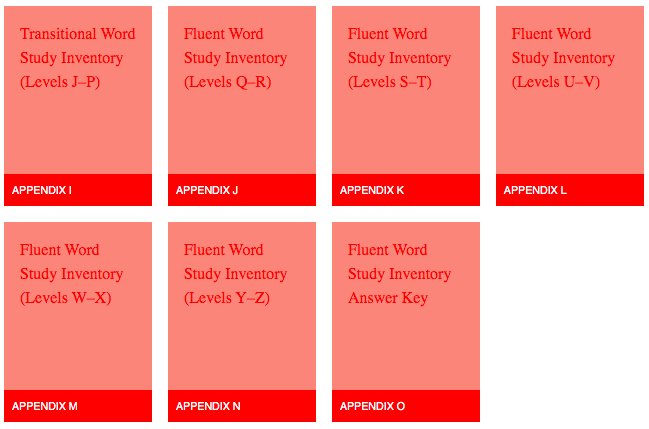
Below are images of what the online site has to offer. Each tool you'd need to implement word study in small groups is provided, as well as pertinent information to strengthen your practice and grow as an educator.




I'll leave you with a few quotes to give you better insight into what the book offers. I highly recommend you own the book. If you're anything like me, you'll read, highlight and tab the book, then refer to it again and again when planning for small guided groups. 
  • Word study goes beyond the rote memorization of letters and sounds. It teaches readers how to apply their knowledge of letters, sounds, and words in order to read and spell (p.9).
  • Word study, including phonics, should be taught in small groups and based on the developmental needs of individual students (p.13).
  • The key phrase is "developmentally appropriate," not one size fits all (p.13.)
  • It doesn't make sense to teach word study the same way to every child (p.16).
  • Emphasize meaning and practice flexibility! (p.21)
  • Spelling a word is not an efficient way to learn sight words. In fact, it will slow the rate at which students acquire them. You want students to remember sight words as one complete unit (p.29).
  • It is important for students to understand, from an early age, that what they read must make sense. As students read, prompt them to use what they know about letters and sounds to help them make sense of the text (p.100).
  • A goal of every guided reading lesson is to teach students how to use their newly acquired word study skills while they are reading and writing (p.237).
  • Create a love for reading by knowing your students' reading interests. Each day students should read books they select themselves (p.170).
  • Learning to read does not need to be a drudgery. The biggest message we want to leave you with is that learning should be joyful (p.198).
Check out #NSFWordStudy on Twitter for more information. :)

Thanks for taking a peek and if you're interested in snagging a free copy, leave a comment below to be entered in a giveaway!

"Preventing Misguided Reading: New Strategies for Guided Reading Teachers" by Burkins & Croft

Reflection, reflection, reflection. I have grown a great deal as a professional educator over the past 21 years, first as a classroom teacher and now as a Reading Specialist. I've taken risks, made mistakes, failed, as well as succeeded, through trial-and-error attempts within my instruction. After diving into the book, Who's Doing the Work? How to Say Less So Your Readers Can Do More by Burkins and Yaris last summer, I became better enlightened in effective practices for the next generation of guided reading instruction. That book truly altered my perception of what quality guided reading instruction should look like. I wrote a post dedicated to Who's Doing the Work?, so if you're interested in reading it, click HERE.
When I heard Burkins, the co-author of Who's Doing the Work?, had co-authored another book dedicated to guided reading, I quickly logged into Amazon and purchased Preventing Misguided Reading: New Strategies for Guided Reading TeachersFor this post, I simply want to highlight some of the authors' thoughts, but as you can see from the Table of Contents below, the book is jammed packed with worthwhile content. There are 6 chapters, each clarifying a misunderstanding about guided reading. The chapters are then broken down into 27 strategies that further support teachers with their guided reading practices. 
When I first started teaching, Fountas and Pinnell were my foundation for teaching reading. Over the years, I've added to my professional reading shelf, but the *yellowing copy* of my first guided reading book still remains. Fountas and Pinnell introduced guided reading back in the 1990's, but somehow, what they intended for teachers has transformed into something quite different. 
However, Burkins and Croft aim to clear up this unintended transformation and the confusion surrounding guided reading. This book helps empower teachers to refine their instruction and helps students become proficient readers. Below are quotes taken from their book. 
  • Education is littered with the remains of educational trends lost in translation. Often, the reality is that we compromise fidelity of their implementation (p.xv).
  • In many cases, guided reading has become prescriptive and regimented, even though guided reading lessons should be responsive to the needs of particular groups of readers, because sound reading instruction is all about knowing how individual students interact with text (p.xvii).
  • ...Fountas and Pinnell (1996) explain that 'the purpose of guided reading is to enable children to use and develop strategies "on the run" (p.xvii).'
  • In terms of guided reading, we believe there is merit in adjusting some of our practices for the sake of preserving an instructional model that focuses on reading processes rather than discrete reading skills (p. xix). 
  • Educators tend to use the  terms 'guided reading' and 'small-group reading' interchangeably. Small-group reading instruction, however, is often not guided reading. Small- group reading instruction may also be shared reading, word work practice, read-aloud, and so forth (p.xxi).
  • Guided reading is not really about levels, benchmark texts, or offering the right prompts to students when they struggle with words. Rather, guided reading is, for us, about supporting students as they develop strategic approaches to meaning making (p.xxi).
  • Students' processes will vary across texts, so a student may demonstrate a balanced reading process in one text and a print dependence in a more difficult text (p.7).
  • Our destination is reading independence (p.11).
  • ...if we teach students to let the text support them, we foster more independence in students. In order to do this, we can teach students to rely on the text rather than on the teacher for scaffolding (p.12).
  • In the simplicity of the daily read-aloud resides a powerful tool that defines and depicts the role of the reader and the act of reading (p.13).
  • We want students to understand from the very first day of shared reading that the act of reading is story driven, or, more simply, an act of discovering what the author is telling us (p.15).
  • The direct teaching of skills and strategies should largely occur outside of guided reading (p.16).
  • We believe that connecting instruction across modeled, shared, guided, and independent reading allows teachers to gradually shift to the students the responsibility for the literacy work (p.18).
  • ...scaffolding has evolved into helping, which we sometimes offer through extensive and specific prompting. We can instead engage read-aloud, shared reading, guided reading, and independent reading to systematically scaffold students as they learn how to help themselves (p.27-28).
  • Rethinking our guided reading structures within the gradual release of responsibility can give us more flexibility, more success, and less frustration (p.28).
  • ...we find ourselves working for "wonders", or digging for "treasures", when students are in texts that are too difficult for them. Their success rests on our support, or our effort, rather than their independence (p.31).
  • [Allington] further states that "many, many students are confronted daily by texts tat are too complex for optimal learning". In contrast, many educators believe that, in instructional-level texts, "the difficulty of the text and tasks needs to be beyond the level at which the student is already capable of independent functioning [Tyner] (.32)."
  • If guided reading is beyond student skill levels, how then can they take these skills into independence? (p.32).
  • Most important in terms of text selection, the guided reading book must be manageable for the readers (p.47).
  • By giving students texts they can manage, we nurture and solidify their abilities to integrate and consolidate various sources of information efficiently and practice the smoothly operating system that is the bedrock of learning to read (p.47).
  • The idea that readers move in precise ways through neatly defined stages and levels, and that they progress through these levels in systematic, chronological order, does not fit with what we have seen of beginning readers. In fact, Clay (1991) writes, "Fluctuations in performance, large leaps forward, movements backward in text difficulty to consolidate or recapitulate are movements to be expected under satisfactory conditions of instruction" (p.55).
  • Again, learning to read is less about level and more about the reading process (p.65).
  • We need to teach even our youngest students to think of reading as meaning making and to act on texts in sophisticated ways to access these meanings (p.70).
  • The more you support students' understanding of cross-checking through modeled and shared contexts, the more you are likely to see students cross-check in guided reading (p.85). 
  • We find the power of learning to administer running records (and IRIs) invaluable to informing instructional decisions... (p104).
For more information, I highly recommend reading the book. You can also take a peek at the resources below that accompany the information in Preventing Misguided Reading. Just click on the images to download your own copies of the resources! 
I hope you found the information in this post helpful. Thanks for stopping by and have a great weekend!

P.S. You can't go wrong when the author thanks you on Twitter for the post. See? This is why I love Jan Miller Burkins' so much. XO


Sight Word Entry Codes for Practicing Sight Words

Sight Word Entry Codes. Ever heard of them? I learned of this idea back in October of 2016 at the Illinois Reading Conference, but figured it's better late than never when sharing an idea, especially when I'm seeing my students' instant sight word recognition sky-rocket and hearing visitors to my school positively comment on it. I've already shared the idea on my microblogging accounts back in October (Twitter and Instagram), but am now just sharing it with my blogging PLN. #whoops

If you already follow me, you are aware I'm a Reading Specialist working with struggling readers, mostly in the younger grades. Many times, the lack of a solid sight word bank is what prevents my students from reading fluently. Of course, there are other factors, but practicing sight words is tremendously helpful. 

The gist of this idea is that students are assessed on their sight words, then given daily practice of three to six words they struggle with by using *entry codes*. Students must tap and accurately read the words in any order on their entry codes before they are allowed to enter the room. (Support is allowed, when needed!) Once the students master the sight words on the entry codes and in their reading, the codes are updated to a new list. I've even had students master all of their sight words, so their entry "requirement" is to give me a fist bump for a job well done. It's a simple way to strengthen their sight word foundation. 

I realize this idea may be a tad overwhelming for a classroom teacher of 28 students, since I mostly pull groups of 3-5 students at a time. Yes, having so few students reading their words before entry to the classroom is definitely more manageable. However, if you are a classroom teacher, an idea is to switch up the name of these codes (Starter Codes?) and place them on a table top flip chart. When pulling small groups of students, have them read the words before starting their rereading of familiar texts. If you are a Kindergarten teacher, entry codes of letter naming and sounds are also an option. Just some thoughts. :)

Since I began implementing this idea back in October, I've altered the format of the codes. At first, I had a full sheet of paper with 6 sight words on a themed-image for each month. For example, I've used clipart images of pumpkins, turkeys, pine trees, snowballs, hearts, shamrocks and now bunnies. I have since downsized the codes to a half sheet of paper, as well as added the students' faces using fun FREE apps that go along with either the holiday or season. You'll see the progression of the entry codes in the images below. 
Some of my *fist bump* kiddos!
So, there you have it...another simple idea to help support your students with sight words.

Happy Reading!

"What's in the Bubble?" Reading Strategy from The Reading Strategies Book

If you have been following my blog, you know how fond I am of Jennifer Serravallo. She started her educational career as a classroom teacher and has become, in my eyes, one of the most genius literacy consultants and authors out there. On the very first page of The Reading Strategies Book, Serravallo states, "The strategies I've crafted in this book stand on the shoulders of decades of research and master teachers from whose work I've been fortunate to learn." Educators can't go wrong with teacher tested and approved strategies that are backed by research!

After spearheading a book study dedicated to The Reading Strategies Book last year, I have since fallen in love with the book over and over again. I routinely review it in search of support strategies for my struggling readers. I am never disappointed and often feel I've hit the jackpot of resources. If you own the book, you know exactly what I mean. My copy (above) is highlighted, dogeared and tabbed all over the place. 

Since I'm a Reading Specialist servicing a handful of grade levels, I have invested time in making mini charts for strategies my RtI students often need. Invested time, meaning I've photocopied the images from the book, sized them to fit in my mini tabletop pocket chart, cut them apart and laminated them. When they are in the tabletop chart, I have the ability to swap the strategy visuals out for the different groups. However, I also place large anchor charts of the strategies most of my kiddos need throughout my room
Let's forge ahead to the strategy called "What's in the Bubble?" found on page 167 in the book. This strategy falls under Goal 6- Supporting Comprehension in Fiction: Thinking About Characters. It is best used with students reading at Levels C through M and is focused on the skill of inferring. If students are to fully comprehend fictional texts, they need to better understand characters by being able to infer character feelings and traits. In Serravallo's words, here is how she explains the strategy to students:
We can pause and think, "What's my character thinking here?" or "What might my character be saying here?" Even when the text doesn't tell us, we can imagine, noticing what's happened so far. Pause on the page and put a thought or speech bubble above the character in the picture, point to the bubble, and say what the character might be thinking.
The student pictured below is in 3rd grade and is reading at a Level I. I service him one on one for various reasons. When asked a question, he often responds by reading the text, which of course isn't a true response because he's just reading words. For instance, if I were to ask, "What do you think is happening here on this page?", he would automatically begin reading the text without even trying to answer the question. Since this is the case, I modified the activity when working with him to better meet his needs. 
I first placed sticky notes over the text and had him just look at the pictures. I asked him "What might this character be thinking?" in various spots in the book as we flipped through the pages. We discussed his thoughts orally before I had him write anything down on the thought clouds using some of the suggested prompts below. After just looking through the book, I gave him four thought clouds and explained to him that he may begin reading, but throughout the reading he will need to stop to write down what the character on that page may be thinking. 
He did an amazing job with the activity and was able to write character thoughts that went well with the images. He loved the thought clouds and wanted to reread the story. (Yay!) To switch it up a bit, I had him remove the clouds from the correct page and jumble them up. He then reread the book while placing the clouds onto the page that correlated with the image. I was able to use "Yes! That thought matches with what's happened so far." from the suggested prompts below.
Overall, it was a successful strategy for this student. I'm pleased with the results. If you would like to try this strategy with any of your students, but don't own the book (Why don't you own the book?!), you will find the recommended student prompts Serravallo suggests below. 
  • What just happened? So, what might your character be thinking?
  • What words is your character saying in his or her head?
  • Before you turn the page, pause and think about what he or she would be thinking.
  • Put your thought bubble on that page.
  • That's what's happening. What might she or he be thinking?
  • Yes! That thought matches with what's happened so far.
  • Pausing there helps you think about what the character's thinking.
One last tip: For students reading at the lower levels (Level C, for example), Serravallo mentions using thought clouds on tongue depressors. Students may place them on the book pictures to orally tell about the characters' thinking, which can be done independently or with partners. The image below shows the thought clouds I created for my students.

Happy reading!

Related Posts Plugin for WordPress, Blogger...