Pages

Showing posts with label Heinemann. Show all posts

Quick PD Idea based on Serravallo's "Understanding Texts & Readers"

Here's a quick idea based on Jennifer Serravallo's new book, Understanding Texts & Readers: Responsive Comprehension Instruction with Leveled Texts. The amazing ladies over at Tiny Tips and Teeny Tales shared an Instagram post about a Text Bands PD they were going to present. I was able to take the idea and run with it, so my staff may also benefit from the book's contents. Thanks, Ladies!

The images below show a simple chart that explains the characteristics of Plot/Setting, Characters, Themes/Ideas, and Vocabulary/Figurative Language at each text band ranging from Level J to Level W. The chart shown is geared toward fictional texts. I'm optimistic the contents can better support teachers in conferring more productively with students because they will be able to see how the demands placed on the reader change as the complexity increases. I'm hoping to create a similar chart dedicated to informational texts. Coming soon!
Enjoy. :)

A Peek into Some Emergent Strategies from Serravallo's "The Writing Strategies Book"

Have you perused Jennifer Serravallo's The Writing Strategies Book: Your Everything Guide to Developing Skilled Writers, yet? After getting my hands on The Reading Strategies Book: Your Everything Guide to Developing Skilled Readers back in 2015, I was ecstatic when I heard a writing version of the book was in the works. I waited on pins and needles for it to be delivered, since I preordered months beforehand. Once the book arrived in February 2017, all I could say was Ooh la la! 

Oh, Jennifer Serravallo! What can I say besides she is like no other. If you follow my blog, you know I consider her to be one of the most genius literacy consultants and authors out there. I had the pleasurable opportunity of meeting her in person at a conference I attended at the tail end of the 2016-2017 school year, but was able to catch a few of her sessions at the Illinois Reading Conference this past October. She is an accomplished, yet, genuinely kindhearted and down-to-Earth person. She was willing to sign all of the books I currently own that she has authored, as well as take the time to sign books from the hundreds of others who attended.  
Before moving on, I'd like to preface that much of this post has been sitting unpublished for many, many months. It has been revised over and over, but to no avail...until now. I was going to participate in a comprehensive book study with some of the wonderful members of the #ReadingStrategiesCrew like we did for our previous book study on The Reading Strategies Book. However, for a handful of reasons, we decided to cancel the study. 

Nevertheless, I figured I could share some of the emergent strategies I used with my students and my own kids at the tail end of last school year. Since I'm in a new school this year and in a new role as a Literacy Coach, alongside being a K-2 Reading Specialist, I tested out some strategies that could be used to support kindergarten and first grade students. Praises for Jennifer's work deserve to be sung worldwide!

Since I mostly work with very young students, I tried out a few strategies with my emergent writers from last school year, including my own kids who were in preschool at the time, but have now moved on to kindergarten. I wanted to give you a peek into a few strategies represented in Goal 1.

Goal 1 is Composing with Pictures. There are eighteen strategies within this goal to support pre-emergent and emergent writers. This goal is mostly used to support students in pre-Kindergarten through 2nd grade. However, Serravallo mentions that students throughout the primary grades benefit when they are given time to sketch their ideas before moving into the writing process. 

Below is a snapshot of the strategies reinforcing this goal. Just like Serravallo's The Reading Strategies Book, the format is not the typical front cover to back cover type of read, but another handy guidebook to support your instruction. The format allows teachers to pick and choose from researched-based strategies that will best scaffold students. Serravallo states, "I streamlined the language and examples, and I present the strategies in a format that is organized so that the busy teacher can find just the right strategy at just the right moment."  Ahhh, music to my ears.  
For each strategy, once again, Serravallo includes a description and helpful prompts to use with students. Many of the strategies also provide Teacher Tips and samples of Lesson Language to use when putting the strategy into practice. The strategies can be demonstrated to individuals, small groups or whole class. In addition, along the sidebar of each strategy, Serravallo indicates the level (emergent to grade 8), genre/text type, and process(es) in which to focus. I find these to be invaluable features of the book (just as in The Reading Strategies Book) because even a novice or experienced classroom teacher without a writing background can fully support and guide his/her students in writing. This book elicits powerful writing instruction!

In view of the fact I work with struggling readers at school, which often correlates to weak writing abilities, as well as have little ones at home in the early stages of writing, Goal 1 suited me perfectly. An example of Reread Your Pictures to Teach (1.4), Label Your Pictures (1.6) and A Series of Pictures to Show Change (1.13) are discussed in this post. All eighteen strategies within this goal are worthwhile, of course

If you teach young students or have little ones at home who are budding writers, you're aware of how tricky writing letters and words can be for some. Serravallo explains that writing instruction can begin well before students are even able to connect letters into words and words into a piece of writing. She added the work of researchers Ray and Glover stating, "By teaching children to compose with pictures, they can be freed up to create texts in any genre and to understand that meaning comes first, long before they are ready to spend lots of mental energy hearing the sounds in words and writing down what they hear (p.34)."

Reread Your Pictures to Teach   
The Reread Your Pictures to Teach strategy focuses on students orally explaining facts about a chosen topic. Here are the *Who's this for?* stats: Level: emergent, Genre/Text Type: informational/nonfiction, Process: reading writing aloudThis strategy encourages students to retell their *writing* in picture form. Be mindful when thinking about writing children's words for them on their pictures. The Teaching Tip for this strategy comes with a forewarning: 
"Some teachers record students' speech right on their writing/pictures, but many believe this negatively impacts a student's agency and confidence for writing words when she is ready. When an adult writes on a child's paper, this may communicate that the child's attempts at making meaning don't make sense without the teacher's written words, which may undermine her future attempts at writing pictures and/or with words (Ray and Glover 2008)." 
Image from The Writing Strategies Book
After reading about this strategy, my own preschool kiddos popped into mind. At the start of Spring in 2017, they began learning at school all about the the life cycle of a chicken. We took a family trip to the library, checked out a few books, built a little background and then began extending our learning about chickens. Below are some pictures taken in their preschool classroom and at home.
Once my kids learned a bit more about the life cycle of the chicken, my daughter began drawing what she learned and then reread her pictures to teach her father all about it.
To get a better sense of the Reread Your Pictures to Teach strategy for informational/nonfiction writing, here are a few ideal prompts found in the book:
  • What does this picture teach about?
  • Point to a part and tell me what I can learn from that.
  • Do you know other facts?
  • What does this part of the picture teach?
  • Sound like a teacher.
  • Your drawing teaches a lot of facts about the topic!
Label Your Pictures
The Label Your Pictures strategy is self-explanatory. Students draw a picture, then use sounds they know to label their images. Here are the *Who's this for *  stats: Levels: emergent-K, Genre/Text Type: any, Process: draftingThe Teaching Tip suggests students be assessed on letter-sound identification prior to use of this strategy. If students have a strong foundation of letter-sound correspondence, they are typically ready for for labeling. However, the Teaching Tip also forewarns:
"Pushing the conventional writing/print too soon could overly focus the child on getting down words rather than other qualities of good writing such as structure and elaboration (p.43)." 
Image from The Writing Strategies Book
My son, on the other hand, began drawing what he learned and then labeled his pictures to teach his father and me all about his newly found knowledge. His pictures are below.
The Label Your Pictures strategy can be used with any genre. Serravallo suggests using prompts such as these:
  • What sounds do you hear?
  • Say the word slowly.
  • What letters make that sound?
  • Write the letter down, and say the word again?
A Series of Pictures to Show Change

A Series of Pictures to Show Change strategy focuses on students being able to depict how real life things can move or gradually change over time. Here are the *Who's this for?* stats: Levels: emergent-2, Genre/TextType: narrative, informational/nonfiction, procedural, Process: drafting

Image from The Writing Strategies Book
For this strategy, I enrolled some of my willing and eager first grade boys last year who were really into learning about frogs. The book How Frogs Grow found in the F&P LLI kit is what piqued their interest, so I found some other related titles I had on hand. Below are some snapshots of their work, as well as a video of one who wanted to share his learning.
The prompts for A Series of Pictures to Show Change strategy can be used with narrative and informational or procedural genres, so below are some recommended prompts that compliment this strategy:
  • Who's that? What's happening?
  • What did she do next?
  • Can you draw that next part in a new picture?
  • What's the next thing she does?
  • Draw a picture to show what it looks like when it starts. 
  • Draw a picture to show how it changes. 
  • Draw a picture to show how it changes again.
So, there you have it, a few strategies to implement in your classroom with emergent-level students. The book is worth owning, so if you don't already own a copy, hop on over to Amazon A.S.A.P. ;)

Happy Tuesday, folks!


Amplify Your Instruction with Kristin Ziemke and Katie Muhtaris!

Good morning! If you weren't already aware, my school district participates in biweekly Twitter chats using the hashtag #D100chat. I love participating in the chats because they promote professional growth as an educator and bring the colleagues in my district closer together. As you know, collaboration is viewed as one of the keys to success! Our Twitter chats focus on a variety of topics, including district-wide professional book studies, content-area literacy, ELL resources, SAMR & TPACK, genius hour, CCSS math practices and more.  

I know it's late notice, but our next chat is today, May 3rd! The topic is all about amplifying your digital learning and instruction. Can you guess who our guest moderator will be? Kristin Ziemke!  Katie Muhtaris and Kristin Ziemke wrote the book Amplify: Digital Teaching and Learning in the K-6 Classroom.  If you don't own it, I highly recommend the purchase. It's filled with tons of useful tips, tech resources and great pedagogy.  


A group of teachers in my district decided to try some ideas from their book to prepare for the upcoming chat.  The book has specific sections called Three Things to Try Tomorrow. The ideas in these sections are easy-to-implement and could dramatically enhance our teaching and students' learning. Why not give the ideas a try, right? If you feel you're not a "techie" kind of teacher, don't fret. You don't need to be when putting these purposeful ideas into practice!


The Challenge: Try Something!
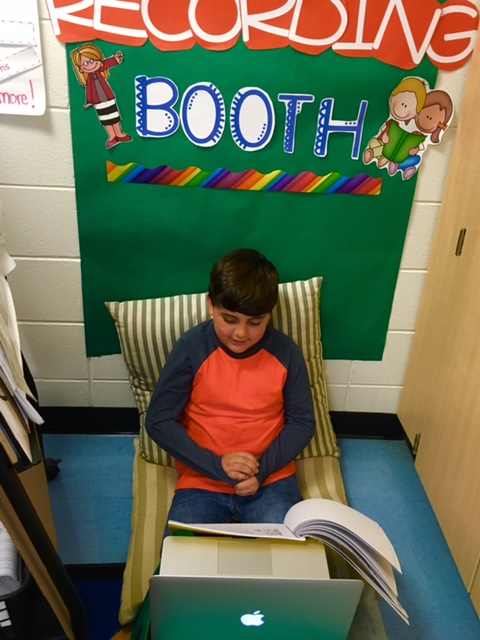
I decided to try two *somethings*, but I have a feeling, little by little, more and more ideas will be incorporated into my class. In recent weeks, I've created a Recording Booth and Digital Bulletin Boards for my students. Both of these ideas are found in the first chapter of Amplify. According to Ziemke and Muhtaris, "A class recording booth is one of the easiest ways to capture student thinking. You can create a recording booth with practically any device... Once you have a device, find a quiet corner in your classroom and start recording!" It truly is that simple. Really!

The digital bulletin board is considered any digital collaborative space you create for students to gather feedback or allow interaction among each other. There are a variety of options, but Padlet was mentioned as a favorite by the authors. Padlet is a purposeful tool that can be manipulated by students with ease. As mentioned in Amplify, "Padlet walls support images, videos and links."


The Lesson:
Since my students are already used to recording themselves in my room, I thought adding a makeshift recording booth would be simple enough. Generally, my students find a spot in the room to record various tasks, such as book trailers for their books (accessed through the use of QR Codes), their thinking about what they're reading, and even themselves reading books aloud to reflect on their fluency. The step-by-step introduction and modeling of how to record oneself was launched at the start of the year, so I was able to quickly move through the suggested tips by Ziemke and Muhtaris. Because I am in a 1:1 district, K-5 students have become well aware of the procedures for recording themselves. The management piece isn't a big focus for me, since I provide interventions for groups of 3-4 students at a time. However, two of the suggested starting points from the book are:
  • Start by modeling for students what the video should look like.
  • Add supports like a chart depicting how to start, record and stop the camera. 


For the digital bulletin board, Padlet is a great way to go.  I've been using Padlet (as well as TodaysMeet) with my students for a few years now with different intentions in mind.  Amplify gave me additional ideas for using this platform with students, such as shelfies.  Students post comments on the Padlet wall about what they are reading.  This idea ties into Donalyn Miller's  Status of the Class, where students are held accountable for independent reading.  As Miller states in her book, Reading in the Wild,  "Students practice discussing books in concise, low-risk ways; Everyone reads, everyone shares; Students hear about many books they may potentially read."  The same goes with the Padlet walls!  The images below are from our "What are you reading?" and "Padlet Pride" digital boards.  
My Reflections:
As I reflect, the recording booth was a *bestseller*, in the eyes of the students. They smiled when seeing the sign leading to our makeshift booth, as well as enjoyed the comfy pillows and colorful, green-screen background. I intend on upgrading the booth little by little with a shower curtain and other welcoming details mentioned in the book. If you don't already know, I share a small room with our talented Literacy Coach and part-time Reading Specialist, Courtney. She also pulls kids at the same time as me, so our room can get a low roar of voices at times, but nothing that disrupts the students' learning. Having the recording booth area dedicated in a space removed from other students has been very helpful. Nevertheless, I'm looking into an attachable microphone for the recording booth device, to help improve the sound quality of students' recordings.

The digital bulletin board is a fun way for the students to get ideas and inspiration from their peers. The students are loving the Padlet walls. Even though it's a digital board, I printed out a set of the students' shelfies for the passers-by in the hallway.  Yes, I decided to go *old school* this time and print their shelfies on paper (no throwing rocks, please!). Of course, digital bulletin boards can be shared with others via Schoology, Google documents, or even through the use of QR codes.
Your Turn to Take the Challenge!
Do you integrate tools into your classroom that enhance instruction while using technology, either from Amplify or beyond?  Or do you want to try creating a recording booth for students to document their thinking and/or share their favorite books like I did? How about testing out a digital bulletin board with your students?  We would love if you share your idea with us, either on your blog, by adding a quick idea to our Padlet Wall or linking up below!  We will officially challenge our district (and YOU, if you're outside of Berwyn South District 100) after the #D100chat on 5/3/2016, but you are free to take a sneak peek!

Happy Tuesday!


The Book Study Has Begun! The Reading Strategies Book: Goal 1- Supporting Pre-Emergent and Emergent Readers

Welcome to the book study on Jennifer Serravallo's The Reading Strategies Book: Your Everything Guide to Developing Skilled Readers presented by the #ReadingStrategiesCrew!  Since this is not a typical book, think of it more as a *strategy discovery* study.  I am joining forces with fabulous teacher bloggers to discuss reading strategies from this amazing professional text.  We are thrilled to share our thoughts on this comprehensive and practical book including 300 sensational, easy-to-implement reading strategies for students in grades Kindergarten through 8th Grade.

Each teacher blogger in the #ReadingStrategiesCrew will give you a peek into one of the 13 goals represented in this text.  Within each goal are, of course, valuable strategies to support your ability to prompt and guide students to deepen their skills as readers.  Because it supports such a wide range of readers, teachers can also guide students to more complex texts throughout the year with these strategies! 

The #ReadingStrategiesCrew decided we would each share 2 to 3 strategies within our selected goal, so please keep in mind I'm only highlighting a few strategies my goal has to offer.  We're hoping to spark thoughts on a plan of action for the start of your school year. 

I'm kicking off the study by saying Jennifer Serravallo is awe-inspiring.  She started her educational career as a classroom teacher and has become, in my eyes, one of the most genius literacy consultants and authors out there.  She states on the very first page, "The strategies I've crafted in this book stand on the shoulders of decades of research and master teachers from whose work I've been fortunate to learn...I feel grateful to be part of a profession where there is so much sharing and commingling of thinking..."
Let's get started with Goal 1: Supporting Pre-Emergent and Emergent Readers.  There are twenty strategies within this goal to support pre-emergent and emergent readers.   Below is a snapshot of the strategies reinforcing this goal.  The format of Serravallo's *literacy bible* {in my terms} is not necessarily a front cover to back cover type of read, but more of a handy guidebook of sorts.  Serravallo compared it to a cookbook of recipes.  The format allows teachers to pick and choose from research-based strategies that will best scaffold students, just as a cook would pick and choose recipes from a cookbook.   
  
For each strategy, Serravallo includes a description of the strategy and helpful prompts to use with students.  Many of the strategies also provide Teacher Tips and samples of Lesson Language to use when putting the strategy into practice.  The strategies can be demonstrated to individuals, small group or whole class.  In addition, along the sidebar of each strategy, Serravallo indicates the level (pre-emergent to Levels R and above), genre/text type and skill(s) in which to focus.  I find these to be invaluable features of the book because even a novice or experienced classroom teacher without a reading background can fully support and guide their students in reading.  This book elicits powerful reading instruction! 

The 3 strategies I will be discussing are Linger FingerExpress the Emotions and Keep in Mind What Repeats.  It was very difficult to narrow in on only 3 strategies to discuss.  Once you own the book, you'll understand why. :) In view of the fact I work with struggling readers and oftentimes encounter students rushing through their books, reading in a monotone voice and taking the time to sound out words that continuously repeat in a text, I chose these particular strategies.  

Have you ever heard a student say, "I can't read"?  I'm sure you're nodding your head up and down, especially if you work with the younger student population in the pre-emergent and emergent stages of reading.  Well, Serravallo has been convinced by various researchers that "We can meet students where they are and help them engage with and enjoy books, make meaning, acquire vocabulary, use text features to understand, connect the pages, respond to the texts by writing and talking, practice their fluency, and perhaps above all, develop identities as confident, engaged, joyful readers {even without decoding} (p.21)".  Agree?  I bet you're nodding your head up and down again. 
Focus Strategy One: Linger Finger  
The Linger Finger strategy focuses on noticing details.  It encourages students to slow down and deliberately inspect, if you will, all the details a text has to offer.  I regularly stimulate conversations with my students discussing how books offer wonderful illustrations, text features and other *goodies* for readers to appreciate, be entertained by and learn from.  Too often my youngest readers rush through their books, only to shout, "I'm done!"  If you've encountered this same scenario in your classroom, you should consider implementing this strategy with your students.  Below is a simple anchor chart found in Serravallo's book to create with your students as a reminder to take it slow, or linger, while reading.  This anchor chart along with the catchy title for this strategy are a nice *hook & sinker* for students to remember to take their time while reading. 
To get a better sense of the Linger Finger strategy, here are a few ideal prompts found in the book: 
  • Move your finger across the page.  Tell me what you see.
  • Not so fast!  Stay on the page a moment.
  • You went across the whole page and said sentences about what you saw!
  • What will you do before you turn the page? (p.26)
Focus Strategy Two: Express the Emotions
The Express the Emotions strategy develops fluency and expressive reading.  It provokes students to think about how a character in a story may be feeling and then asks students to use a voice to sound like the character.  This strategy is very practical and easy to implement.  It triggered memories of particular kiddos I've worked with in the past.  Most likely, we've all encountered a few students who sound as if they're robots while reading...those who utter words on the page in a tiresome, monotone voice, almost as if they are reading while sleeping.  Yes?

Serravallo's teaching tip for this strategy is to model fluent, expressive reading in various parts of a book to show students a myriad of emotions present in a text and to help students tap into their inner actor (p.31).  I love that phrase because we know little actors and actresses can develop in all of our readers. :) Serravallo also mentions students who are not yet decoding can still make meaning from illustrations and expressively *read* the pictures.  The anchor chart below can be created in the classroom during a mini-lesson and serves as a reminder for students to read with expression.
For the Express the Emotions strategy, Serravallo suggests using prompts such as these: 
  • How did the character say that?  Show me.
  • Say it thinking about how the character is feeling.
  • I could tell he sounded happy (or mad or sad) because of how you read that.
Focus Strategy Three: 
Keep in Mind What Repeats
The Keep in Mind What Repeats strategy fosters students to be text detectives by finding repeated patterns in a text, together with noticing what parts are new on each page.  Brown Bear, Brown Bear, Chicka Chicka Boom Boom and We're Going on a Bear Hunt were cited as appropriate books to use with this strategy.  They each include parts that repeat alongside parts that change on the page.  When students become more mindful of repeated patterns while reading, they'll become more fluent, and we all know fluency aides comprehension.  Therefore, being mindful helps them better monitor for meaning.  Note the anchor chart below as an example of one teachers could create with their students in the classroom. 
The prompts found in the book for the Keep in Mind What Repeats strategy are
  • What's the same on this page?
  • Say what repeats.
  • Check the picture to see what's new.
  • How is this page different from the last?
  • How is this page similar to the last?
You may be asking yourself, "What books do I use to support the students working on this goal?"  Well, Serravallo contemplated that, too.  I'm here to assure you, she thought of EVERYTHING while writing this book.  EV-ER-Y-THING!  Serravallo's suggested criteria for books helpful in supporting pre-emergent and emergent students are as follows:
  • texts that are visually engaging
  • stories that have a strong narrative with recognizable dialogue, and some repetition
  • informational texts that offer opportunities to learn content from the photographs and other features
  • list books with clearly supportive pictures
  • alphabet and number books to help reinforce knowledge of letters and sounds and numerals connected to a number of objects (p.22)
I'm hoping I gave you helpful insight into a few strategies found in Goal 1: Supporting Pre-Emergent and Emergent Readers.  After diving into this text and reflecting back on my own teaching instruction, I came to the realization I implement many of the strategies already.  I bet you do, too!  The strategies I discussed probably sound familiar to ones you've implemented with your students.  However, I think having a name/title for each strategy and a goal in which the strategy reinforces will definitely aid me in keeping organized and focused during my lesson planning.  

Looking ahead to this school year, I intend to implement oodles of strategies from The Reading Strategies BookThere are 300 strategies to choose from, therefore I need to use this book as "a menu not a meal".  I heard that saying many years back at a Reading First conference.  It stuck with me as a reminder to choose what works best for my students and me.  There is no need to use every single strategy if the situation doesn't call for it.  Right?

Serravallo states, "An ideal classroom is one in which every student has a clear goal, based on reliable formative assessment information." Because of this, my course of action is to continue observing and conferring with my students, writing detailed notes and deciding which direction to take my instruction to move them forward as dynamic, independent readers.  I'm eager to use Serravallo's book as a GO-TO resource filled with dog-eared, highlighted, tabbed and marked pages to remind myself of these worthwhile strategies.  I deem this a mentor text for any teacher involved in teaching reading to students! 
Image Source- Lori Squalls created this image and was happy to share.  
Thanks, Lori!  If you're looking for a good Twitter follow, check her out! 
In case you're interested, last year I created the activity below to provide a simple, yet, fun way for my students to practice reading dialogue expressively.  It seems to nicely complement the Express the Emotions strategy.  Click the image if you would like to view it in my TpT Store. 
Before you go, enter the Giveaway for a chance to win a copy of Jennifer Serravallo's The Reading Strategies Book: Your Everything Guide to Developing Skilled Readers!  Entries will be taken until the end of the day on August 17th.  A winner will be announced on August 19th, so stay tuned!
a Rafflecopter giveaway
The #ReadingStrategiesCrew would also love for you to share your thoughts in the comments section or link up your own blog post below.  The link up will remain open in case you don't have the book, yet, and want to write a post in the future. :)

Questions to Consider:
  • As you plan your lessons, what might be some ways you prepare yourself to support pre-emergent and emergent readers in your classroom?
  • What do you want to be mindful of when working with readers needing support with this goal?
  • If you do not teach pre-emergent and emergent readers, how can you apply your knowledge of these strategies with your developing readers?
Well, thanks for stopping by Literacy Loving Gals to kick off the book study!  As the study continues in the upcoming weeks, the hyperlinks to each teacher blogger's post will be added below to help keep the goals organized in one spot.  We hope you continue to follow along with us! :)
  1. Literacy Loving Gals: Goal 1 Supporting Pre-Emergent and Emergent Readers
  2. My First Grade Happy Place: Goal 2 Teaching Reading Engagement
  3. The Literacy Spot: Goal 3 Supporting Print Work
  4. EduKate Dawson: Goal 4 Teaching Fluency
  5. Love to Teach A Latte: Goal 5 Supporting Comprehension in Fiction~ Plot and Setting
  6. An Apple for the Teacher: Goal 6 Supporting Comprehension in Fiction~ Thinking About Characters
  7. Owl Things First: Goal 7 Supporting Comprehension in Fiction~ Understanding Themes and Ideas
  8. Inspire Me ASAP: Goal 8 Supporting Comprehension in Nonfiction~ Determining Main Topic(s) and Idea(s)
  9. Beginnings with Baer: Goal 9 Supporting Comprehension in Nonfiction~ Determining Key Details
  10. Mrs. B's First Grade: Goal 10 Supporting Comprehension in Nonfiction~ Getting the Most from Text Features
  11. I'm Not Just a Teacher: Goal 11 Improving Comprehension in Fiction and Nonfiction~ Understanding Vocabulary and Figurative Language
  12. Digital Divide & Conquer: Goal 12 Supporting Students' Conversations
  13. Where the Magic Happens: Goal 13 Improving Writing About Reading


Related Posts Plugin for WordPress, Blogger...