


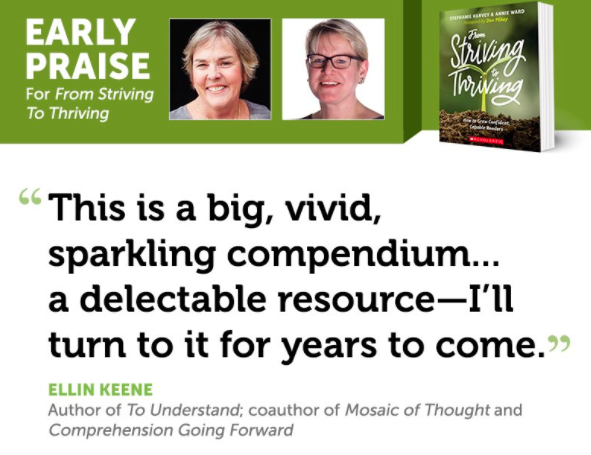
From Striving to Thriving: How to Grow Confident Capable Readers, written by Stephanie Harvey and Annie Ward, has been receiving top-notch praises by valued literacy professionals, including Debbie Miller, Kylene Beers and Penny Kittle, for a variety of reasons. However, my favorite reason being their determination to let go of labels. Right out of the gates, the authors state their book 'grew out of a shared and evolving recognition that far too many striving readers are suffering unproductive and unintended consequences of the very instructional tools and approaches designed to support their growth (p.11).' This statement refers to book leveling systems. Educators need to remember leveling systems are a teacher's tool, not a child's label.
As I anticipated the arrival of my copy, I looked toward my PLN to learn more via tweets, blog posts and reviews featuring its high standing on professional literacy bookshelves.

Before the book was even in my hands, I was ready to *table the labels* and empower children to grow from being striving to thriving readers. When the book finally arrived, I began to delve into its greatness. The book lived up to the hype!
Today, I'm here to share with you a bit of its greatness. However, please realize, this post scarcely highlights the vast prowess of the authors. I'm here to bestow upon you a multimodal praising and sharing of quotes and tips taken directly from the book, in addition to tweets dedicated to it. Since the framework of this professional text encompasses three parts, TRUST, TEACH, TRANSFORM, I've decided to organize the tips and tweets to follow suit. Read along to get a glimpse of what the book offers.
INTRODUCTION:
- We replace the dooming label "struggling reader" with the dynamic, effort-based term "striving reader" because it connotes energy, action and progress (p.10).
 |
- In short, with this book, we seek to close a massive "knowing-doing gap" by doing the best of what's been known for decades: providing all children with daily access to books that jolt their hearts and turbocharge their minds, abundant time to read, and sound instruction in essential skills and strategies grounded in close observation and conversation (p.12).
- We're simply asking that you think beyond your students' scores and any labels they've been given, and get to know them as multidimensional people (p.13).
- Remember, we are always teaching the striver- not a program (p.13).
- Always, the key is to give our strivers access to the full force of language: reading, writing, speaking, and listening (p.21).
- A reading level certainly indicates to some degree a reader's proficiency. But reading is about much more than levels (p.23).
- Our goal is to make sure that our students remain students and don't become labels (p.27).
PART I: TRUST


Chapter 1: Table the Labels
- Teaching reading to striving readers is rocket science! Learning how to teach them to read is an ongoing, lifelong process (p.38-39).
- Kids view themselves as learners based on how we view them (p.39).

- Rather than simply telling kids to work harder, teachers can share strategies and resources that help kids engage in the learning process, believe in themselves, make progress, and come to understand that intelligence is not fixed and minds are malleable (p.44).


- We need to offer strivers content they simply can't resist (p.45).
- The more we focus on engagement, the less we need to focus on grit and stamina. Change the book, change the reader (p.46)!

- Whereas proficient readers are often encouraged to read about and investigate their passions, strivers are so overloaded with worksheets and assorted "edu-tasks" that they rarely get time to do that (p.47).

- We have found that referring to mistakes as attempts decreases kids' fear of being wrong and increases their desire to have a go (p.49).


Chapter 2: Cultivate Curiosity


- Researchers conclude that many children spend hours a day in school without asking a single question (p.73).
- We need to cultivate that innate curiosity and capture our striving readers with compelling ideas, artifacts, issues, and generally irresistible content (p.73)


- We make our curiosity visible by modeling our thinking and questions so kids see that adults are continually asking questions (p.77).

- The tech opportunities from apps such as Google Docs, Drawing Pad, Edmodo, and Padlet are endless for inspiring curiosity, asking questions and doing research. We recommend apps like Drawing Pad, which allow kids to draw rather than write their thinking, giving striving readers a boost (p. 83).
Chapter 3: Ensure Access to and Choice of Books
- Build a library for the readers you expect; customize it for the readers you meet (p.94).

- Access and choice can't happen without offering students a full range of genres and formats (p.99).


- Series books are to the striving reader what spinach is to Popeye: a super food (p.101)!


- It's therefore imperative that teachers partner with school and community librarians to assess kids' interests, book-match relentlessly, and maximize circulation (p.111).


- Having worked to build a robust and diverse collection, it's vital that we enthusiastically endorse wide and wild reading without judgement (p.114).
Chapter 4: Pump Up the Reading Volume
- Like drivers, readers acquire confidence by logging miles in books; they recognize challenges they have seen and navigated before (p.124).

- The overwhelming benefits of voluminous engaged reading compel us to give all kids a whopping daily dose and make it a foremost intervention for striving readers (p.126).

- Children not only become better readers through voluminous, engaged reading, they also become more informed, principled, empathetic people (p.126).

- We educators must vow to do no harm to striving readers and provide them with the reading volume they need and deserve...daily structures erode the amount of time striving readers spend reading in school and at home (p.133)!
PART II: TEACH

Chapter 5: Book-Match Relentlessly

- Book-matching is vital in putting striving readers on a a reading path. It's labor intensive, but it's a labor of love (p.144).


- Book-talks and next-up lists...are effective whole-group strategies to help most thriving readers find appealing reading material (p.148).

- Even when a striving reader is off and running, it's important to monitor the match carefully. Like a delicate flame, the striving reader needs attention, but not so much that it smothers him or her (p.154).


- As we seek to move striving readers up their personal reading ladders, we must remember to keep pleasure and success at the forefront of our minds; there must be a favorable effort-to-reward ratio in each of the successive texts we recommend (p.155).

- Therefore, we can not emphasize enough the importance of sending kids home with books. While this doesn't guarantee that kids will read those books, it increases the likelihood dramatically (p.159).

Chapter 6: Teach Thinking-Intensive Reading

- When striving readers come to understand that reading is thinking and that strategies are tools to aid understanding, confidence grows, reading flourishes, and possibilities open (p.168).


- When striving readers come to understand that reading is above all about meaning making- telling a story or sharing information- rather than calling out individual letters, sounds, and words one by one, their perception of reading changes (p.171).


- The ultimate goal is for striving readers to have a small repertoire of strategies at their disposal to construct meaing and build knowledge (p.175).


- ...we take care to avoid "over-instructing" our striving readers. It is tempting to continually build in time to instruct striving readers. But there is a fine line between appropriate scaffolding and over-scaffolding (p.177).
- We hold kids back if we allow them to get information only from texts they are able to decode (p.181).
- We don't read merely for the sake of it; we read to build our knowledge store. So, when we limit striving readers to only texts they can read, they may miss out on that important act (p.190).
PART III: TRANSFORM

Chapter 7: Assess Readers in the Round
- Yetta Goodman, who coined the term "kidwatching", and Gretchen Owocki explain the power of kidwatching: Rather than viewing some children as "low", "behind", or "lacking in skills", teachers who kidwatch view all children as creative, capable learners- on their way to "achieving control over the conventions of language- always in process," always moving forward (p.208-209).


- The most powerful way to reach a striving reader is to spend five or ten minutes engaging with him in what Annie refers to as a "reader-to-reader, heart-to-heart conference" (p.211).
- First and foremost, remember: Assessment is inquiry. You might think of yourself as a researcher in your own classroom, gathering data that you can use to shape your instruction and help your students see concrete evidence of their learning strengths (p.224).
- The ultimate goal of assessment as inquiry is to draw students into the inquiry and help them self-monitor, track, and document their own progress (p.226).
Chapter 8: Advocate Tirelessly

- It is a cruel irony that striving readers, who deserve and urgently require the greatest access to captivating books, often have the least access (p.232).
- "There is no secret ingredient. It's just you." This means you must double down to provide access, choice, and time for each of your striving readers by insisting that each one has appealing independent reading books every day, whether or not he or she receives additional interventions (p.239).
- Above all else, own the all-important responsibility of being the guardian of kids' reading lives; don't abdicate it or assume someone else is doing it (p.240).

Discover any new insights? I hope so! If you're on Twitter, my all time favorite platform for impromptu professional development, you can track down some great content under the hashtag #FromStrivingToThriving. For literacy insight on a daily basis, give Stephanie Harvey and Annie Ward a follow on Twitter. You can also see Stephanie Harvey on YouTube. I've linked her Ten Tips below. Just click on each image to be directly connected to her YouTube videos discussing each tip.
Last, but not least, I have a copy of the book to give away! Please leave an insightful comment about how you are growing confident capable readers in your classroom to be entered for the drawing. I will randomly select a winner from the comments this Saturday, December 2. Click HERE for a sneak peek at the book's Introduction.
Last, but not least, I have a copy of the book to give away! Please leave an insightful comment about how you are growing confident capable readers in your classroom to be entered for the drawing. I will randomly select a winner from the comments this Saturday, December 2. Click HERE for a sneak peek at the book's Introduction.
Happy Learning!


